| Wed. February 18, 2026 |
 |
|
||
|
||||
| ||||


By Dr. Muzammil Ahad Dar
The world order in the twenty-first century keeps facing more turbulence. Things happen all at once in ways that build on each other. Disruptions come from pandemics and clashes between nations. They also stem from big changes in technology and shocks from the climate. Standard ideas in international relations cover power well enough. They touch on institutions and how identities form. Realism liberalism and constructivism give useful views there. Still those approaches fall short when it comes to crises. They do not fully explain why some countries fall apart under pressure. Others manage to adjust and even come out stronger. This work brings in Dynamic Adaptive Realism or DAR. It also presents the Spontaneity Framework for international relations. These serve as fresh ways to look at staying alive and holding sway amid wild ups and downs in the system.
DAR changes how we see state power. It moves away from just piling up hard resources like weapons or money. Instead, it focuses on adaptive capacity. That means the organized skill to make things up improvise and adjust when nothing is certain. At the heart of this setup lies spontaneity. We see it not as rash moves but as built-in room to bend and shift. DAR points out three ways spontaneity turns into real strategy. One is redundancy with varied and layered ways to rely on things. Another involves experimentation through low-risk trials and learning from policy steps over time. The third covers cognitive flexibility. Leaders use it to recast crises and change their big-picture strategies.
These elements in DAR show why nations with limited means can still bounce back strong. Meanwhile states that look mighty on paper turn fragile without the right setups for adapting. The whole framework gives ideas for reshaping how the world runs together. It stresses polycentric setups that flex and link up in networks. Those forms of working together matter more now.
In times when things stay shaky as the usual state, DAR makes the case that adapting equals real strength. Spontaneity keeps you going. This shifts international relations thinking to match what actually happens in our century.
The twenty-first century has thrown countries into a time marked by chaos, things happening all at once, and one problem leading to another in ways that build up fast. The COVID-19 pandemic displayed how weak global health systems are. Then came Russia’s invasion of Ukraine, which changed security in Europe and disrupted energy supplies. At the same time, the growing competition between China and the United States affects trade, tech, and even ideas that people hold. The climate crisis keeps getting worse. It impacts the world with shocks that pile on top of each other. Experts now call this mix of problems a polycrisis. Historian Adam Tooze helped make that term popular in 2022. It draws from earlier ideas by people studying systems and global risks. Thomas Homer Dixon wrote about it in 2015, predicting how failures could hit everywhere at the same time.
Standard theories in international relations do not quite handle this situation well. Structural realism was the big idea in the late nineteen hundreds. It focuses on how material power is spread out. Survival comes from having more power than others, according to Kenneth Waltz in 1979. But that idea has trouble explaining some things. Countries like Russia and Venezuela have lots of resources. Yet they struggle when things get tough. Meanwhile, places like India or South Korea show strength you might not expect. Liberal ideas stress how institutions and rules help keep things steady. Still, top experts admit these setups often get stuck. Climate change, diseases spreading, and fights between countries cause gridlock, as Thomas Hale, David Held, and Kevin Young noted in 2013. Constructivism looks at identities and norms in a good way. It does not provide many tools for dealing with real world changes during big shocks, though. Alexander Wendt talked about that in 1999.
All these approaches miss something key. They do not fully see the role of spontaneity: the way states can adjust on the fly when things are unclear. People often think of spontaneity as just acting without thinking or in a messy way. In science that studies complex systems, it means something different. It is about how systems adapt as they emerge in changing, hard to predict conditions. Ideas from ecology about how systems bounce back have looked at this for a long time. Charles Holling wrote on it in 1973. Those concepts help connect to how states act right now.
We need a fresh way to look at this. Call it Dynamic Adaptive Realism, or DAR. It goes back to realism’s main focus on staying alive. But it shifts from fixed strengths to how well something can change. Shocks come suddenly these days. The world around strategies can shift in months, not years. States last not just because they are strong. They last because they adjust in smart, fast, and bendy ways.
In DAR, spontaneity is not some last-ditch random move from being cornered. It is built in flexibility. States design it on purpose. That lets them change paths, rules, and alliances when stress hits. DAR points out three ways this flexibility happens: redundancy, experimentation, and cognitive flexibility.
Redundancy means setting up extra layers that overlap for strength. It comes from ideas in engineering and how groups work. You build in backups, side routes, and spread out what things depend on. If one part fails, the whole does not crash. In world politics, this shows up in varied trade deals, talking to many sides in diplomacy, other energy options, buying weapons from different places, and teams that can shift. The European Union rushed to find new gas sources after Russia’s moves in 2022. They learned what happens without enough backups. India pulls energy from the US, Russia, and Gulf countries all at once. That is the other side of it. Redundancy looks wasteful when times are calm. It turns vital when everything shakes, much like what Karl Weick and Kathleen Sutcliffe found in studies of reliable setups in twenty oh seven.
The next part is experimentation. Countries that do well in unsure times create spaces where it is okay to try things and fail a bit. Policies get tested, changed, grown, or dropped without breaking everything. This can happen with small local tests, power spread out to regions, rules that allow playing around, or step by step fixes. It lets learning happen as things unfold. Chinas economy changed a lot after 1978. Scholars like Sebastian Heilmann in 2008 described how they tested ideas in safe spots first. Then they spread what worked nationwide. This way, they adapted without the whole system falling apart. It shows DARS point that strong setups grow through loops of trying and feedback. They do not stick to hard set plans.
Cognitive flexibility is the last one. It is the hardest to pin down. Crises make leaders deal with fuzzy info, changing rewards, and mixed messages. If they hold too tight to old beliefs or habits, they miss what is really going on. The ability to rethink crises, take in fresh details, and shift plans makes a big difference. Studies in how politics and minds work show this. Being rigid raises chances of bad choices while being able to switch views helps states react better. Philip Tetlock wrote on it in 2005. In leading countries, this means reframing issues, updating what matters most, and using plans that fit the moment.
These three things, redundancy, experimentation, and cognitive flexibility, support DARS main idea. Being stiff leads to weakness. Being able to change brings real strength. The places handling late global hits best are not always the ones with huge money or armies. They have spread out strategies, bend ties in talks, spread out ways to create new things, and include leaders who can adjust quick. However, ones that fall behind often are stuck to one main resource, hard set groups, or views that will not budge.
DAR has large effects on how the world runs together as well. Groups like the World Trade Organization, the UN Security Council, and the UN climate body were created for steady, rule-following dealings. Not for shocks that chain together. As they falter, countries turn more to alternative teams such as small clubs for climate, quick help paths for emergencies, side trade deals among a few, and money safety in regions. This show spontaneity built-in. They overlap, adjust, and reshape quickly. They suggest a world run by many centers, fitting the issues, not top-down control.
In the end, DAR pushes thinkers and leaders in international relations to question power at a time when crises are every day. Power now is not just forcing, scaring off, or ruling others. It is changing to fit, keeping choices open in strategy, and making do when old ways fail. Spontaneity turns into the key way strategy grows, not some throw away move.
With global shocks defining our time, countries building up their ability to adapt will guide what the world order becomes. Ones holding to stiff ways will end up more at risk. The last century favored places good at long-term planning with steady foundations. This one favors those good at planned spontaneity. That is acting with aim even when nothing is sure.
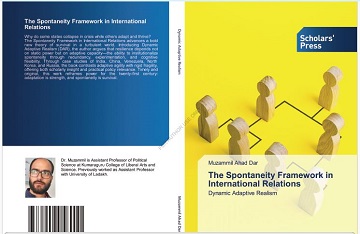
- Dar, Muzammil. Spontaneity Framework in International Relations: Dynamic Adaptive Realism. Scholars Press, ISBN-10:? 6209058019 ISBN-13:? 978-6209058011
Muzammil Ahad Dar is Assistant Professor Political Science, Kumaraguru College of Liberal Arts and Science, India
| Comments in Chronological order (0 total comments) | |
| Report Abuse |
| Contact Us | About Us | Donate | Terms & Conditions |


|
All Rights Reserved. Copyright 2002 - 2026