| Thu. March 19, 2026 |
 |
|
||
|
||||
| ||||


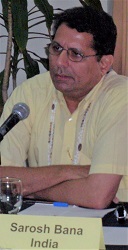
By Sarosh Bana
The Indian government is treading a fine line in the on-going coordinated military operations launched by the United States and Israel against Iran on 28 February, all three its “strategic partners”.
India’s strategic partnership with Iran, forged through the New Delhi Declaration of 2003, precedes its strategic partnership with Washington, signed in 2004, and with Jerusalem, entered into in 2017.
What has been perceived as particularly embarrassing for India has been the Narendra Modi government’s silence on the 4 March lethal attack by a Los Angeles-class fast attack submarine USS Charlotte (SSN-766) - using a Mark 48 heavyweight torpedo – on IRIS (Islamic Republic of Iran Ship) Dena. The 1,500-tonne Moudge-class frigate was homebound after participating in the International Fleet Review and the multilateral MILAN naval exercises hosted by India’s Ministry of Defence at the Eastern Naval Command (ENC) at Visakhapatnam, conducted from 15 to 25 February.
The attack, that killed 87 of the 180 Iranian sailors on board as IRIS Dena was heaved out of the waters of Sri Lanka’s exclusive economic zone (EEZ) in the Indian Ocean, brought the US and Israel’s coordinated military action against Iran uncomfortably close to India.
The Modi government was likely discomfited by this brazen offensive in the neighbourhood as it had hosted the stricken warship, as also permitted another Iranian ship, the 2,500-tonne Hengam-class landing ship, IRIS Lavan, with 184 crew and beset with engine troubles, to dock ?at Kochi port, on the western seaboard, the same day IRIS Dena was blown up.
While 32 survivors were rescued by the Sri Lankan Navy, the Indian Navy – the region’s largest maritime force – deployed Survey Vessel Large (SVL) INS Ikshak and the three-masted barque training ship INS Tarangini for search and rescue operations, apart from maritime patrol aircraft.
Alongside the Iranians, the US too was among the 18 “friendly foreign countries” that were hosted by the Indian Navy for the naval drills, participating with one US Navy P-8A Poseidon maritime patrol aircraft.
Terming the attack “an atrocity at sea”, Iran’s Foreign Minister Abbas Araghchi stressed that the frigate had been “a guest of India’s Navy”.
Indeed, the ENC had said in a post on X on 17 February, “Indian Navy welcomes IRIS Dena, of the Iranian Navy, on her arrival at #Visakhapatnam ... reflecting long-standing cultural links ?between the two nations.” Its post also carried pictures of the warship and some of its officers, and at the conclusion of the exercises, the Command noted, “Friendly foreign navies had participated in high-tempo tactical manoeuvres alongside Indian Naval Ships, reflecting growing convergence of maritime interests towards ensuring safe and secure seas.”
Coincidentally, on 4 March, auxiliary vessel, IRIS Bushehr (422), with 208 crew, too developed an engine snag and was allowed to anchor off the Welisara Naval Base near Colombo. The Dena, Lavan and Bushehr were part of Tehran’s diplomatic naval mission in the Indian Ocean region that had set sail from Iran in the first half of February.
Describing the attack as a “quiet death”, US Defense Secretary Pete Hegseth told reporters in Washington that it marked the first time since World War II that the US had sunk an “enemy ship” using a torpedo. Though Prime Minister Modi has called broadly for “dialogue and diplomacy” to resolve conflicts, he has passed over this ambush in India’s vicinity that took his government totally unawares.
Joint maritime exercise protocol, as for MILAN, requires participating navies to limit their munitions to the planned live firings, surface gun shots, anti-air engagements, and Fleet Manoeuvre (FPM) drills. Hence, IRIS Dena was likely unarmed at the time of the attack, having expended its firepower during the multilateral exercise.
Ironically, both India and the US, along with Australia and Japan, constitute the Quadrilateral Security Dialogue, or Quad, which is committed to deliver shared security in the Indo-Pacific, largely to check unprovoked forays by China into the South China Sea and the wider Indo-Pacific. Intrinsic to this is shared intelligence and information for pre-empting and deflecting any threats in this maritime region.
Understandably, the US’s seaborne ambuscade has sparked debate within India’s strategic community, as New Delhi appeared not to have been sounded out by the Americans, and its own intelligence not having picked up the presence of the submarine.
Although a country may not be legally obliged to inform another before it enters that country’s maritime domain, it has a diplomatic and political responsibility to do so, especially when the two are “strategic partners” and from a collaborative grouping like Quad
While IRIS Dena, in Araghchi’s words, “was lost 2,000 miles [3,218 km] from Iran’s shores”, USS Charlotte had sailed halfway round the globe, being part of the Submarine Force, US Pacific Fleet, homeported in Pearl Harbour, Hawaii, at a straight-line distance of 13,000 km.
Niggling questions arise: Would the US have attacked an enemy warship if it had been a guest of the Australian or Japanese navies, without first sounding out Canberra or Tokyo? Would Australia and Japan have overlooked the act committed close to their waters? Is the Indian government being viewed as a pushover incapable of defending its sovereignty?
This presumptuous act recalls another equally embarrassing incident for the Indian government, when the Arleigh Burke class guided missile destroyer, USS John Paul Jones (DDG 53), from the Yokosuka-headquartered US 7th Fleet had on 7 April 2021 transgressed into India’s EEZ.
Later that day, the 7th Fleet commander issued a statement, widely perceived as unusual, even combative, and which affirmed, “This freedom of navigation operation (FONOP) upheld the rights, freedoms, and lawful uses of the sea recognised in international law by challenging India’s excessive maritime claims.”
Curiously, the ‘international law’ referred to was the 1982 United Nations Convention on the Law of the Sea (UNCLOS), to which the US is not a signatory as it disagrees with certain provisions, though the Law has been ratified by 167 countries, including India, plus the European Union.
The fleet’s statement that it was “challenging” India appeared provocative, and arrogant, implying Washington’s disregard for the enduring strategic partnership it enjoys with New Delhi.
UNCLOS grants each coastal state exclusive sovereignty over its EEZ, which extends 200 nautical miles from its coast. India’s EEZ measures 2.2 million km . To safeguard this sovereignty, the convention allows the coastal state to take necessary measures, including boarding, inspection, arrest and legal action, to ensure compliance with international laws and regulations.
The Law considers any passage of a foreign ship prejudicial to peace and security of the coastal state if it engages in activities that include ‘any exercise or practice with weapons of any kind’, ‘the carrying out of research or survey activities’ or ‘any other activity not having a direct bearing on passage’. However, UNCLOS has no agency for suo moto action against the offender, but leaves it to the aggrieved state to take matters up for arbitration.
The Indian government may well have downplayed the intrusion, but the 7th Fleet’s defiant declaration precluded any such possibility.
In a rejoinder issued two days after the 7th Fleet’s statement, India’s Ministry of External Affairs emphasised that the US destroyer ‘was continuously monitored transiting from the Persian Gulf towards the Malacca Straits’ and that the government has conveyed its concerns regarding this passage to the US government through diplomatic channels.
This claim of continuous monitoring raises yet another niggling question: Was the Indian government aware of USS Charlotte’s movements and intent and yet chose to remain muted?
A corollary question would be: Did the government then consider it prudent to not sound out Tehran about the impending transgression to target an Iranian vessel it had hosted?
SAROSH BANA is Executive Editor of Business India in Mumbai, and Regional Editor, India/Asia-Pacific, of Naval Forces, published out of Germany. He focuses on Defence & Security, Cyber Security, International Affairs, Policy, Strategy, Space, Power & Energy, and Environment & Conservation. Sarosh studied in India, Switzerland, Germany and Hawaii, and was on the Board of the East-West Centre (EWC) Association, a Hawaii-based think tank.
| Comments in Chronological order (0 total comments) | |
| Report Abuse |
| Contact Us | About Us | Donate | Terms & Conditions |


|
All Rights Reserved. Copyright 2002 - 2026