| Tue. July 28, 2026 |
 |
|
||
|
||||
| ||||


By Zainab Imran
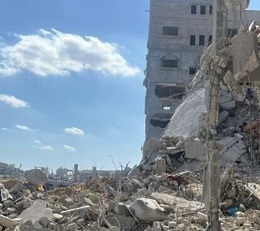
War leaves behind a lot; silence, dust, broken walls and empty spaces where the normal life had been. It exposes bedrooms to the elements, turns kitchens into rubble, finds school books under concrete, and turns streets into topography barely recognizable. And maybe the big deadweight that war leaves is rubble--not merely broken rock, but the ruins of memories, habits and lives abruptly terminated. Rubble is normally regarded as the ultimate product of destruction. Here ends the stories. But where I was? Two sisters gazing on that rubble and envisioning a start.
In front of the rubble of their war-blown house, Tala and Farah Mousa decided to find hope in something that the world post-war lacks, possibility. In places where others perceived failure they found content. And where others saw rubbish, they saw opportunities. Bit by bit they started to gather up as much broken concrete as they could, crush it, play with it, mold it again into re-usable bricks. Out of the war wreck they wove something, which could re-weave. Something very touching about that picture--not merely because it is new, but because it is bigger than new. It is a refusal as though. A temptation not to allow destruction to have the last word.
Buildings are not the only objects with which war is fought. It is opposed to memory and stability as well as imagination. It is not simply a physical loss but its attempt to make people believe that nothing can be restored to its former glory. The future itself has been of the ruins interred. Yet this is where history time and again comes in with human beings defying amazingly. Occasionally opposition is vocal and partisan. Even the protest or diplomacy make it visible at times. Battering is less vocal at times. It does sometimes occur in the hands of young girls in the midst of broken concrete, and who are set to make it some service.
It is what makes the story of Tala and Farah so powerful. They never started with resources, the laboratories or support. They started out with a loss. What war had left behind them they started with? But, as a result of that demolition, they made bricks, however, not as a means to achieve a more environmentally friendly solution or even as a real building material but something symbolic. They have a deeper meaning to their work than engineering. Every brick seems to be in answer to destruction itself. This can still give rise to a statement saying something. However, it is possible to make something. It is possible to reconstruct something.
The Earth Prize made known their project to the world and right in the right cause. However, that is but one aspect of the story. The deeper story had started many years before the realization, in the silent contemplation when cameras were turned off and there were no applauses. It commenced by their standing in the midst of ruins and posing a question many mighty institutions, even now, fail to respond to: what can we do with what stands? Their response was both down-to-earth and very human. Reuse it. Rebuild with it. Will not even waste the rubbish.
Everywhere there is rubble in Gaza. It clogs the roads, neighborhoods open spaces and sites of homes that some time existed. It is painful to many people, a reminder on what has been lost. To Tala and Farah it was the root of what was to follow. Such a change is what leaves their stories in the mind. Since it is not merely a recycling garbage. It is concerning redefining the meaning of debris per se. Using something which is related to destruction and making it a weapon of reconstruction. By taking witness of loss, and
And there is something too, very unpleasant--very suggestive--about this story. Adults build wars. The ruins of these are passed should the children inherit. The crucial political choices are made in remote rooms, but in most cases, it is common families that bear the brunt. Even there, it is commonly ordinary people who, however, start operations of rebuilding initially. Prior to the creation of policies. Prior to the financing of reconstruction plans. Prior to the world answering. They start off on their hands. What there is too frequently use. With whatever remains. That fact is what contributes to the fact that this narrative of two sisters is both uplifting and beatific heartbreaking at the same time.
All of Gaza will not be rebuilt using their bricks. They are not able to forget mourning, to change all homes or rebuild all the lives which are lost. No project was that one burdened. However reconstruction has never commenced with all being restored simultaneously. It starts very small compared to that. It starts with one piece raised off the ground. One idea. One wall rebuilt. A brick on top of another. and, above all, with the hope that yet it can be restored.
Tala and Farah have made something which is not just a construction material. In its physical form, it signifies strength. The strength not as a motto, but as work. As dust-covered hands. As persistence. As fancy living where it must not have lived. Their music makes us remember that hope may not be loud. At times hope is feasible. It has an appearance of being incomplete. Occasionally it comes along with grey dust.
We get lost in a world full of images of destruction that we may forget to listen to images of repair. Yet repair matters. To mend is another sort of resistance. It thrusts itself in opposition to despair. It even demands that despite destruction, the creation is still possible. That life, but still wounded, still has ways to find.
Perhaps that is why the tale of Tala and Farah is echoed all the way over Gaza. Since it addresses something general. Every society is burdened with a kind of ruin--physical, emotional, historical. And everybody in his own way or other is attempting to make something out of what is left. It is a great answer to that struggle that these two sisters propose. They took the fragments of their world that were left broken, and made them be something that can be used to hold another thing.
And maybe the greatest thing of all: out of rubble they created bricks. They brought hope to view.
Zainab Imran is a Pakistan-based researcher and writer with a background in Peace and Conflict Studies from the National Defense University, Pakistan, and Goucher College, Maryland. Her interests lie in policy research, peacebuilding, and security governance. Through her work, she engages with social and policy issues, drawing on research and analysis to contribute to public discussion and policy thinking.
| Comments in Chronological order (0 total comments) | |
| Report Abuse |
| Contact Us | About Us | Donate | Terms & Conditions |


|
All Rights Reserved. Copyright 2002 - 2026