| Tue. July 07, 2026 |
 |
|
||
|
||||
| ||||



Britain once exported parliamentary stability to the world. Today it can barely keep a prime minister past a single budget cycle. When Keir Starmer told the country on 22 June 2026 that he would step down as Labour leader, he became the sixth person to leave Downing Street since the Brexit referendum of June 2016 — four days after Andy Burnham’s landslide by-election win in Makerfield had made the outcome inevitable (Al Jazeera 2026). Burnham, the MP for Makerfield and former mayor of Greater Manchester, is the heavy favourite to succeed him; if he does, Britain will have had seven prime ministers in a decade that opened with David Cameron governing for six years and is closing with leaders who barely last two.
It would be tidy to treat each departure as a story about a flawed individual: Cameron’s miscalculation, May’s stubbornness, Johnson’s recklessness, Truss’s inexperience, Sunak’s bad timing, Starmer’s caution. But six failures spread across two parties and three different electoral mandates point to something more structural than personality. Brexit did not simply change Britain’s trading relationship with Europe. It rewired the coalitions that had organised British politics since the war, and it left every government that followed with less room than the one before it to manage what came next.
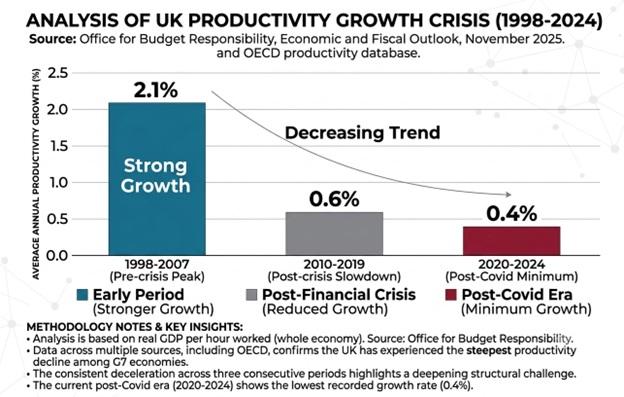
Start with the economics, since it is the least contested part of the story. The Office for Budget Responsibility’s own figures show UK productivity growth averaging 2.1 percent a year between 1998 and 2007, falling to 0.6 percent between 2010 and 2019, and falling again to 0.4 percent between 2020 and 2024 — the steepest such decline of any G7 economy (Office for Budget Responsibility 2025). That slowdown predates the referendum. Brexit compounded it. A 2025 study by Nicholas Bloom and colleagues, drawing on a decade of survey data from the Bank of England’s Decision Maker Panel, estimates that Brexit had reduced UK GDP by 6 to 8 percent by the end of 2025, relative to a counterfactual of continued EU membership; the OBR’s own, more cautious modelling puts the long-run cost at 4 percent (Bloom et al. 2025). Either figure means every prime minister since 2016 has governed an economy with less capacity to deliver visible improvement, which makes the basic work of holding a coalition together — claiming credit for something before the next crisis arrives — far harder than it was for Cameron’s predecessors.
Liz Truss showed how thin that margin had become. Her September 2022 mini-budget, no more reckless than measures earlier chancellors had survived, triggered a bond-market crisis severe enough to force a Bank of England intervention; she resigned forty-nine days later, the shortest premiership in British history. The lesson her successors drew was not that fiscal discipline matters in principle, but that an economy already weakened by a decade and a half of stagnant productivity has no spare capacity left to absorb a policy mistake.
Each fall has its own immediate trigger. Cameron lost the referendum he had called to quiet his own backbenchers. May’s withdrawal deal was voted down three times by a Commons split between Leavers who thought it conceded too much and Remainers who thought it conceded too little. Johnson was undone by lockdown-era scandal. Sunak led the Conservatives to 121 seats, their fewest since 1832 (House of Commons Library 2026). Starmer’s landslide majority, won with just 34 percent of the vote, unravelled within eighteen months as Reform UK’s local election gains eroded his support inside his own party, a slide Burnham’s 54.8 percent and 9,241-vote majority in Makerfield made terminal (UK Parliament 2026). What connects these otherwise distinct stories is that four of the last five transitions happened without a general election, decided inside parliamentary parties rather than at the ballot box — and Starmer’s own departure, being settled through an internal Labour contest rather than a national vote, continues that pattern.
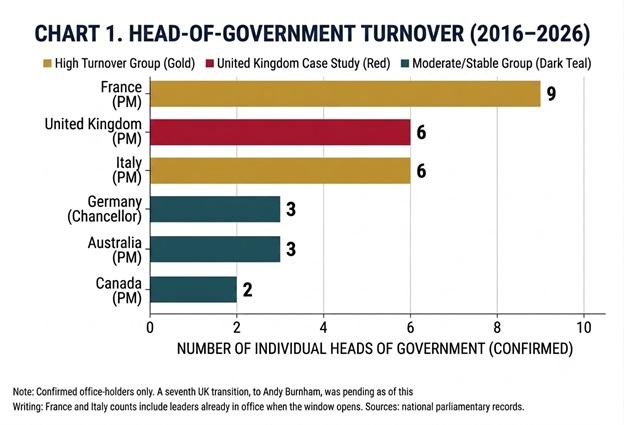
Table. Leadership Turnover in Major Western Democracies, 2016–2026
|
Country (Office) |
Heads of Government, 2016–2026 |
Number |
|
France (PM) |
Valls, Cazeneuve, Philippe, Castex, Borne, Attal, Barnier, Bayrou, Lecornu |
9 |
|
United Kingdom (PM) |
Cameron, May, Johnson, Truss, Sunak, Starmer |
6 |
|
Italy (PM) |
Renzi, Gentiloni, Conte (×2), Draghi, Meloni |
6 |
|
Germany (Chancellor) |
Merkel, Scholz, Merz |
3 |
|
Australia (PM) |
Turnbull, Morrison, Albanese |
3 |
|
Canada (PM) |
Trudeau, Carney |
2 |
Note: Figures count confirmed prime ministers/chancellors only. A seventh UK transition, to Andy Burnham, was pending as of this writing, with nominations opening 9 July 2026. Sources: House of Commons Library (2026); Assemblée Nationale; Bundestag; Camera dei Deputati; Parliament of Australia; Parliament of Canada.
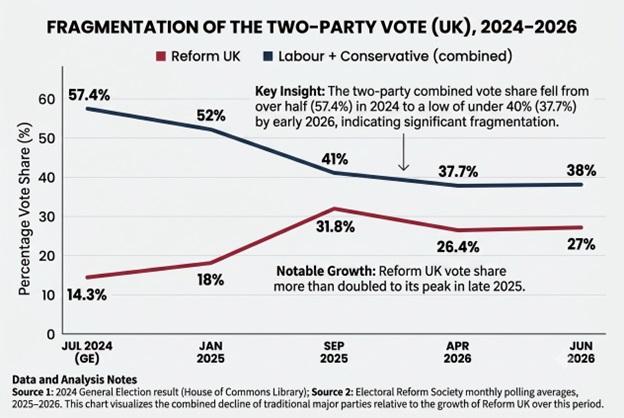
The deeper change is in the party system itself. Reform UK, led by Nigel Farage, overtook both Labour and the Conservatives in national polling by late 2025, peaking near 32 percent that September before settling around 26 to 27 percent by mid-2026 (Electoral Reform Society 2026). The combined Labour and Conservative vote share, 57.4 percent at the 2024 election itself a postwar low, had slipped further, to around 38 percent, in polling by the spring of 2026 (Electoral Reform Society 2026). Britain now has five parties each drawing more than ten percent support, competing for seats under a system built for two. The 2024 result, in which Labour took 63 percent of seats from 34 percent of the vote, was by most measures the most disproportionate outcome in the history of British democracy, and a mandate built on that scale of distortion has little reserve left when opinion shifts even modestly (House of Commons Library 2026).
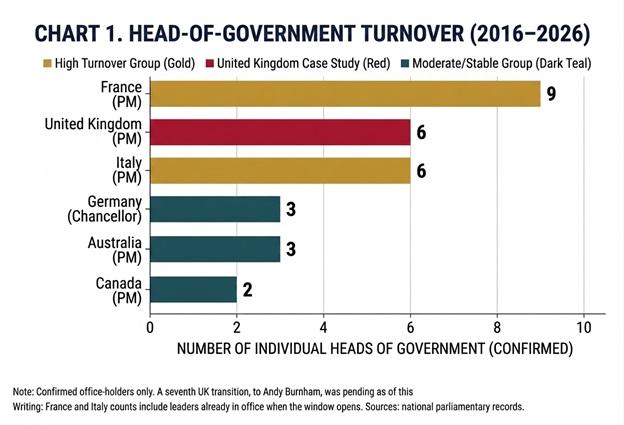
None of these pressures is unique to Britain, and the precise count matters. Germany has had three chancellors since 2016 — Merkel, Scholz, Merz — despite the Alternative for Germany’s rise to become the country’s second-largest party; coalition bargaining and a constructive no-confidence rule insulate the chancellorship in ways Westminster does not insulate the premiership. France, by contrast, has had nine prime ministers over the same decade, three more than Britain’s six, yet President Macron’s fixed term has kept the head of state in place even as governments fall around him, a separation of functions the British constitution does not offer. Canada had a single prime minister, Justin Trudeau, from 2015 until his resignation in January 2025, in a sequence of caucus pressure and ministerial defections that closely mirrors Starmer’s, and has had only one since. Italy, mocked for decades over its short-lived governments, supplies the sharpest counter-example: six prime ministers have held office there since 2016, but Giorgia Meloni’s coalition, continuously in power since October 2022, is due to overtake Silvio Berlusconi’s 2001–2005 government this September as the longest continuously serving administration in the history of the Italian Republic (Irish Times 2026). What sets Britain apart, then, is not stagnant growth alone, not party fragmentation alone, and not an unelected succession mechanism alone — each exists somewhere else in Europe, and France’s count is in fact worse — but the way all three reinforce one another inside a single office that fuses head of government with party leader and can be reassigned without ever consulting a voter.
Ten years on, most Britons say the 2016 vote was a mistake: 57 percent now call it wrong against 30 percent who still call it right, almost a mirror image of the referendum itself, and 55 percent say they would vote to rejoin the EU tomorrow (YouGov 2026). That reversal of opinion has produced no political mechanism for acting on it, because no government since the referendum has had the stability to put the question back to the country. Whether Brexit was right or wrong has become, by now, mostly a matter of identity rather than persuasion. The harder question — whether a constitution built around two disciplined parties can still produce a government durable enough to survive contact with five competitive ones — will pass to whoever takes office after Starmer, not be resolved by his leaving.
Vikas Bhardwaj is a scholar of international political economy, holding a Ph.D. and M.Phil. from the Centre for Russian and Central Asian Studies, School of International Studies, Jawaharlal Nehru University (JNU), New Delhi. His work focuses on economic statecraft, sanctions, energy geopolitics, and global economic governance.
He has worked as a researcher with numerous institutions, including the Indian Institute of Public Administration (IIPA), contributing to multiple policy evaluation projects commissioned by the Government of India Ministries. Bhardwaj holds nine academic degrees and has published in international peer-reviewed journals on the Russian economy, geopolitical conflict, and shifting global power dynamics.)
References
Al Jazeera. 2026. “Why Has Keir Starmer Resigned as UK Prime Minister, and Who Will Take Over?” June 22, 2026. https://www.aljazeera.com/news/2026/6/22/why-has-keir-starmer-resigned-as-uk-prime-minister-and-who-will-take-over.
Bloom, Nicholas, Philip Bunn, Paul Mizen, Pawel Smietanka, and Gregory Thwaites. 2025. “The Economic Impact of Brexit.” NBER Working Paper No. 34459. Cambridge, MA: National Bureau of Economic Research.
Electoral Reform Society. 2026. “What Did the UK Polls Say in April 2026?” ERS Analysis, May 6, 2026. https://electoral-reform.org.uk/what-did-the-uk-polls-say-in-april-2026/.
House of Commons Library. 2026. “General Election 2024: Results and Analysis.” Research Briefing CBP-10009. London: House of Commons Library. https://commonslibrary.parliament.uk/research-briefings/cbp-10009/.
Irish Times. 2026. “Meloni May Soon Be Italy’s Longest-Serving Postwar Leader — But Can Her Government Deliver?” January 9, 2026. https://www.irishtimes.com/world/europe/2026/01/09/meloni-may-soon-be-italys-longest-serving-postwar-leader-but-can-her-government-deliver/.
Office for Budget Responsibility. 2025. “Economic and Fiscal Outlook — November 2025.” London: Office for Budget Responsibility. https://obr.uk/efo/economic-and-fiscal-outlook-november-2025/.
Funding: No funding was received for this research.
Conflict of Interest: The author declares no conflict of interest.
| Comments in Chronological order (0 total comments) | |
| Report Abuse |
| Contact Us | About Us | Donate | Terms & Conditions |


|
All Rights Reserved. Copyright 2002 - 2026