| Tue. July 07, 2026 |
 |
|
||
|
||||
| ||||


By Ioannis Geronimakis
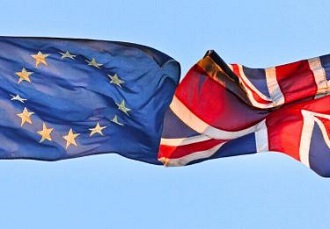
Ten years after the Brexit referendum, the most important question about Britain’s relationship with Europe may no longer be whether the United Kingdom is “back.” It is how it is coming back. The answer is not through economic integration or membership, at least not for now. It is through security.
This is a different kind of European return. It does not require reopening the referendum argument or pretending that Brexit can be quietly reversed. The domestic politics of rejoining the European Union remain difficult, and even the current reset has clear limits. That leaves only a narrow path for rebuilding the relationship. But security has made that path wider. A sense of urgency and the need for action pushed the EU and Britain toward a common course.
The reason is simple. Circumstances have changed faster than the Brexit debate. Russia’s war against Ukraine has made European security more immediate. The United States remains central to NATO, but European governments can no longer assume that Washington will always carry the same political weight in Europe’s defence. Britain, meanwhile, has rediscovered something that Brexit did not remove: geography. The UK may have left the EU, but it did not leave the European security environment.
That is why the May 2025 EU-UK summit mattered. It was the first such summit since the UK left the EU and it produced three documents, including a Security and Defence Partnership. The agreement does not turn Britain into an EU member by another name. It is not a dramatic constitutional settlement. But it creates regular channels for cooperation on support for Ukraine, sanctions, maritime security, space security, hybrid threats, critical infrastructure and defence industrial cooperation.
This matters because the most realistic form of UK-EU cooperation is now practical before it is symbolic. Britain does not need to rejoin the EU to coordinate sanctions on Russia, protect undersea infrastructure, support Ukraine or work with European partners on defence production. The EU does not need to solve every post-Brexit dispute before recognising that the UK remains one of Europe’s most important military and diplomatic actors. In security policy, geography and capability matter more than institutional labels.
Britain also needs Europe for reasons of its own. The Strategic Defence Review 2025 described a “new era of threat” and called for a move towards warfighting readiness in the Euro-Atlantic. It also set out a “NATO first” approach and linked British security more directly to European security. The National Security Strategy 2025 made the same point from a wider angle, identifying Russia as the most acute threat and placing British security inside a more dangerous global environment. This is not the language of a country looking mainly beyond Europe. It is the language of a country trying to adapt to a more dangerous continent.
The point should not be overstated. The UK-EU reset is real, but it is not frictionless. The Centre for European Reform has argued that the reset has made progress, but remains constrained by British red lines and by EU caution over “cherry-picking.” The collapse of talks over Britain’s participation in the EU’s SAFE defence fund showed how quickly strategic agreement can run into political, financial and industrial limits. Chatham House described that failure as a blow to the reset, though not a brick wall.
This is the central tension. Britain and the EU increasingly need each other, but they still do not fully trust the structures through which that cooperation should happen. The UK wants influence without membership. The EU wants British capability without reopening the logic of Brexit. Both positions are understandable. Both also limit what can be achieved.
Security has one advantage over trade: it is easier to explain politically. Supply chains, regulatory alignment and market access are important, but they are abstract and domestically sensitive. A Russian threat, Ukraine’s defence, attacks on critical infrastructure and the future of NATO are easier to connect to national interests. They make cooperation look less like a concession and more like necessity.
This is why Britain’s European return is likely to happen unevenly. It will not begin with a grand declaration that Brexit has been overcome. It will begin through regular foreign policy dialogues, joint work on Ukraine, coordination against hybrid threats, defence industrial projects and perhaps future compromises on procurement. This is not a return to the EU. It is a return to Europe as a strategic space.
For the EU, this also requires adjustment. A stronger European security architecture cannot be built only around EU members if one of Europe’s largest military powers sits outside the Union. For Britain, the lesson is equally clear. Sovereignty is not the same as distance. The UK can remain outside the EU and still recognise that its security is inseparable from the continent.
The old Brexit question was whether Britain wanted to be inside or outside Europe. The new question is whether Britain and the EU can build enough cooperation to make that distinction less damaging. In trade and migration, the answer may remain politically constrained. In security, the pressure to cooperate is already stronger.
Britain is not returning to the European Union. But it is returning to European geopolitics. That return will not be measured by flags, treaties or slogans. It will be measured by whether London and Brussels can turn shared danger into durable cooperation.
Ioannis Geronimakis is a final-year undergraduate student in Political Science and History at Panteion University of Social and Political Sciences in Athens, and has been accepted to the MSc in International Negotiations at the Athens University of Economics and Business. His interests include international relations, diplomacy and global governance. He has completed internships at the Hellenic Ministry of Foreign Affairs and the Embassy of Greece in Slovenia, and has written for "To Vima International" and the "Association for International and European Affairs".
References / Supporting Sources
Note: These sources are included for editorial verification. The article itself uses embedded hyperlinks, in line with IA Forum’s preference for concise, readable editorials.
• Centre for European Reform. (2026). EU-UK relations: Will 2026 be the year to reset the reset?
• Council of the European Union. (2025). EU-UK summit 2025: outcome documents.
| Comments in Chronological order (0 total comments) | |
| Report Abuse |
| Contact Us | About Us | Donate | Terms & Conditions |


|
All Rights Reserved. Copyright 2002 - 2026