| Mon. July 13, 2026 |
 |
|
||
|
||||
| ||||



Executive Summary
The United States built the post-1945 order to lock in its own primacy at a cost it judged acceptable. This article argues that Washington's distancing from that order is neither a passing mood nor a coherent design, but a structural recalibration in which a cost-benefit ledger, more than ideology, is doing the driving. Three episodes anchor the case: the withdrawal from sixty-six international organisations ordered in January 2026, the 2025 National Security Strategy's doctrine of “Civilizational Realism,” and six years of paralysis at the WTO Appellate Body. Set against the Cold War, the post-1991 moment, and the post-2016 turn, and compared with China's selective multilateralism, Europe's reactive search for autonomy, and Britain's imperial retreat, the evidence points to a hybrid trajectory: military primacy retained, trade leadership abandoned, membership itself turned into a bargaining chip.
Introduction
When Volodymyr Zelensky told Donald Trump in February 2025 that America has “a nice ocean” and does not yet feel the war, he was needling at something real: geography still shapes how Washington prices the cost of leadership (CBS News 2025). Six months later, Trump reached for almost the same image unprompted, telling Fox and Friends that Europe worries about Ukraine because the United States has a “big, beautiful ocean” between itself and the consequences (The Daily Beast 2025). Two men on opposite sides of an argument reaching for the same metaphor is a clue to a larger puzzle: why is the architect of the post-war order increasingly treating that order as optional, and is this a temporary swing of the pendulum or a structural transformation of grand strategy? The argument here is that Washington is moving toward transactional statecraft and selective disengagement, driven less by coherent doctrine than by a recalculated ledger of costs and a bipartisan, if asymmetric, erosion of the 1945 consensus. What follows traces that shift through institutions, alliances, trade and domestic politics, sets it against comparable cases of great-power adjustment, and weighs it against the strongest counterarguments.
Historical Background
The order Washington built after 1945 – the IMF, the World Bank, the GATT, NATO – was designed to prevent any single power from dominating Eurasia, keep markets open to American exports, and embed liberal norms in a durable institutional lattice (Ikenberry 2001). For two generations this was bipartisan common sense, its costs modest against the benefits of a stable, dollar-centred world. That calculation shifted after 1991: the peace dividend gave way to costly interventions in the Balkans, Afghanistan and Iraq, China industrialised inside the trading system Washington had built, and European allies were increasingly seen as free-riding on American guarantees. By 2015 the ledger had changed enough that “America First” found an audience across party lines. Table 1 sets out the core architecture and where each pillar now stands.
Table 1. Major Institutions of the Post-War Order and the Current U.S. Position
|
Institution |
Established |
Purpose |
Current U.S. Position |
|
IMF / World Bank |
1944 / 1945 |
Financial stability, reconstruction and development |
Membership retained; influence reasserted through lending conditionality |
|
GATT / WTO |
1947 / 1995 |
Trade liberalisation and dispute adjudication |
Appellate Body appointments blocked since Dec. 2019; adjudication paralysed |
|
NATO |
1949 |
Collective defence |
Membership retained; support increasingly conditioned on the 5% GDP target |
|
UNFCCC / Paris Agreement |
1992 / 2015 |
International climate-policy coordination |
Withdrawal from the Convention itself ordered Jan. 2026 – the only state ever to do so |
|
UNESCO / UN Human Rights Council |
1945 / 2006 |
Education & culture; human-rights monitoring |
Named for withdrawal in the January 2026 memorandum |
Source: White House (2026); Al Jazeera (2026); Hopewell (2025). Data current as of January 2026.
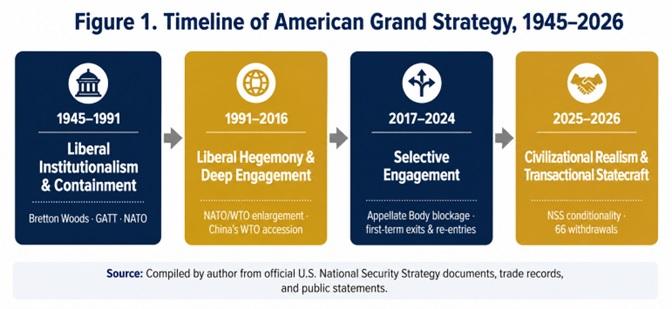
Figure 1. Timeline of American grand strategy, 1945–2026, showing the transition from liberal institutionalism to transactional statecraft. Source: Compiled by the author from GovFacts (2026) and FPRI (2025). Periodisation current as of January 2026.
I. Institutional Disengagement: The Logic of Sixty-Six Withdrawals
The clearest evidence of change is procedural. Executive Order 14199 in February 2025 launched a review of every US membership in an international body, and by January 2026 the White House had ordered withdrawal from sixty-six organisations – thirty-five outside the UN system and thirty-one within it (White House 2026). The list ran from the expected, such as the UN Human Rights Council, to the more consequential: the UN Framework Convention on Climate Change itself, the 1992 treaty underlying the Paris Agreement, from which Washington's second withdrawal – announced in January 2025 – also takes effect this same month (Al Jazeera 2026). Secretary Rubio called the institutions “anti-American, useless, or wasteful” (Fox News 2026); Gina McCarthy, formerly the Biden White House's senior climate adviser, called the decision “short-sighted, embarrassing and foolish” (Brussels Signal 2026) – a reminder that the retreat stays contested at home even as it proceeds. What distinguishes this episode from earlier retrenchment is scale: the Paris Agreement, the WHO and UNESCO had each been exited and rejoined before, but no prior administration attempted a single-memorandum exit from dozens of bodies at once.
II. NATO and the Price of Protection
Alliance politics show the same logic on a slower fuse. NATO's 2014 Wales pledge of 2 percent of GDP was, for most of the following decade, aspirational: only three allies met it that year (NATO 2026). The 2025 National Security Strategy's “Civilizational Realism” raises the floor again – allies committed at the 2025 Hague summit to 5 percent of GDP by 2035, and Washington has tied its own commitment to compliance (GovFacts 2026; FPRI 2025). The compliance count tells the story: three allies in 2014, ten in 2023, twenty-three in 2024, and by NATO's own tally all thirty-two in 2025 (NATO 2026; Al Jazeera 2024) – though SIPRI's independent accounting counted only twenty-two of twenty-nine European members clearing the bar that year, a gap that says as much about measurement convention as burden-sharing (SIPRI 2026). What complicates the picture further is Washington's own spending: US military expenditure fell 7.5 percent in 2025, to $954 billion, chiefly because no new Ukraine aid package was approved, even as Europe as a whole – a category that includes the war-driven outlays of Russia and Ukraine alongside NATO's European members – raised spending by 14 percent, and European NATO members alone reached $559 billion (SIPRI 2026). Allies are paying more for a guarantee that is, in dollar terms, quietly contracting.
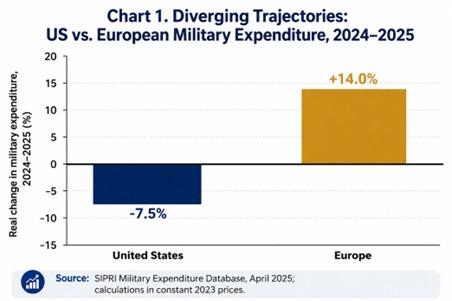
Chart 1. Real year-on-year change in military expenditure, United States vs. Europe, 2024–2025 (%, constant 2024 USD). Data year: 2025. Source: SIPRI (2026). Note: “Europe” follows SIPRI's regional definition, not NATO membership alone.
III. Trade: From Architect to Saboteur
Economic statecraft shows the starkest reversal of all. Washington built the WTO's dispute settlement system in 1995 as the self-described “crown jewel” of the trading order; since December 2019 it has blocked every new appointment to the Appellate Body, leaving it without a quorum and forcing members to “appeal into the void” (Hopewell 2025). By late 2025 the United States had vetoed the reopening of the selection process roughly ninety consecutive times, against the wishes of some 130 WTO members (Harvard International Law Journal 2025). Tellingly, the Biden administration continued rather than reversed the blockage – confirming that the retreat from binding trade adjudication is bipartisan, not an artefact of a single presidency.
IV. The Domestic Ledger
None of this is explicable without the partisan divide beneath it. The 2024 Chicago Council Survey found 74 percent of Democrats but only 55 percent of Republicans believed alliances benefit the United States, a nineteen-point gap; by 2025 that gap had widened to thirty-two points on NATO commitment specifically, even as aggregate support stayed near record highs (Chicago Council on Global Affairs 2024, 2025). That combination – a widening partisan split atop persistently high aggregate support – is itself part of the puzzle: Washington's retreat has run ahead of public opinion, which is why it reads as elite-driven recalibration rather than a democratic mandate for withdrawal.
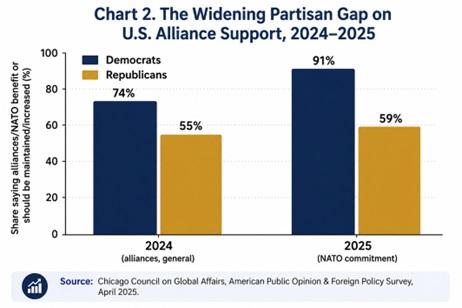
Chart 2. Share of Democrats and Republicans saying alliances/NATO benefit or should be maintained/increased (%). Data years: 2024 and 2025 survey waves. Source: Chicago Council on Global Affairs (2024, 2025).
Table 2. Liberal Internationalism vs. Emerging Transactional Statecraft
|
Dimension |
Post-War Order (1945–2016) |
Emerging Strategy (2017–2026) |
Strategic Implication |
|
Security |
Alliance solidarity; open-ended guarantees |
Guarantee conditioned on the 5% GDP target |
Reduced predictability of extended deterrence |
|
Trade |
Multilateral rules; binding adjudication |
Appellate Body paralysed; bilateral leverage |
Fragmentation into regional trade arrangements |
|
Institutional membership |
Treated as near-permanent |
Reviewed and revocable by executive memorandum |
Allies must hedge against U.S. exit risk |
|
Values |
Democracy promotion as stated doctrine |
“Civilizational Realism,” sovereignty-first framing |
Reduced U.S. soft-power leverage |
Source: Compiled by the author from GovFacts (2026); FPRI (2025); Hopewell (2025). Comparison current as of January 2026.
Comparative Perspectives
Three comparisons sharpen what is distinctive here. China has not exited the order Washington built; it remains active in the World Bank, the WTO and the UN Security Council while layering parallel institutions – the Asian Infrastructure Investment Bank, the Belt and Road Initiative – on top, hedging rather than withdrawing. Europe's “strategic autonomy” project has been reactive rather than anticipatory, gathering real momentum only after 2025, suggesting European capitals still expect the American guarantee to hold even as they insure against its erosion. The more instructive parallel is Britain's negotiated retreat from empire: Suez in 1956 exposed the gap between ambition and capacity, and the 1968 withdrawal “east of Suez” merely adjusted policy to a decline that had already occurred. Washington's position is closer to the inverse – it retains overwhelming relative power and is disengaging by choice, which is exactly why allies read the shift as leverage rather than exit. The Soviet collapse of 1991 offers the sharpest contrast: an empire that stopped paying because it no longer could, not one that chose to stop.
Figure 2. Conceptual framework showing how domestic cost pressures translate, through doctrine, into observed strategic outputs. Source: Author's synthesis (2026) based on the evidence discussed above.
Counterarguments
Defenders of the current course call this recalibration, not retreat: an order built for a world without a peer competitor is being restructured around China through minilateral tools such as AUKUS and the Quad, which deliver focused deterrence more cheaply than universal institutions ever did. There is force in this. But it does not explain why Washington has also disabled a low-cost adjudication mechanism like the WTO Appellate Body, nor why public support for alliances has stayed high even as elite policy moves toward disengagement. Transactionalism may buy short-term burden-sharing gains; the predictability it spends to get them is not easily rebuilt once allies have hedged against its absence.
Conclusion
The evidence assembled here – sixty-six organisational withdrawals, a National Security Strategy that treats alliance guarantees as conditional, six years of WTO Appellate Body paralysis, and a widening partisan gap in public opinion – points to a structural rather than seasonal shift. Compared with Britain's negotiated decline or the Soviet Union's forced collapse, the American case is unusual precisely because it is voluntary: the United States remains the most powerful actor in the system, and what has changed is its willingness to subordinate that power to rules it once wrote for itself. The question this leaves for allies and rivals alike is no longer whether the architect will return to the house it built, but how to live inside a system where the architect increasingly prices its own presence.
Vikas Bhardwaj is a scholar of international political economy, holding a Ph.D. and M.Phil. from the Centre for Russian and Central Asian Studies, School of International Studies, Jawaharlal Nehru University (JNU), New Delhi. His work focuses on economic statecraft, sanctions, energy geopolitics, and global economic governance.
He has worked as a researcher with numerous institutions, including the Indian Institute of Public Administration (IIPA), contributing to multiple policy evaluation projects commissioned by the Government of India Ministries. Bhardwaj holds nine academic degrees and has published in international peer-reviewed journals on the Russian economy, geopolitical conflict, and shifting global power dynamics.)
References
Al Jazeera. 2024. “How Much Is Each NATO Country Spending on Its Military in 2024?” July 11, 2024. https://www.aljazeera.com/news/2024/7/11/how-much-does-each-nato-country-spend-in-2024.
Al Jazeera. 2026. “Which Are the 66 Global Organisations the US Is Leaving Under Trump?” January 8, 2026. https://www.aljazeera.com/news/2026/1/8/which-are-the-66-global-organisations-the-us-is-leaving-under-trump.
Brussels Signal. 2026. “US Leaves 66 ‘Anti-American, Useless, or Wasteful International Organisations.’” January 8, 2026. https://brusselssignal.eu/2026/01/us-leaves-66-anti-american-useless-or-wasteful-international-organisations/.
CBS News. 2025. “Zelenskyy's White House Meeting Ends in Blowup with Trump and Vance over Ukraine's Future.” February 28, 2025. https://www.cbsnews.com/news/ukraine-rare-earth-minerals-trump-zelenskyy/.
Chicago Council on Global Affairs. 2024. “Republicans and Democrats Support US Alliances—for Different Reasons.” https://globalaffairs.org/research/public-opinion-survey/republicans-and-democrats-support-us-alliances-different-reasons.
Chicago Council on Global Affairs. 2025. “US Public Support for Alliances at All-Time High.” https://globalaffairs.org/research/public-opinion-survey/us-public-support-alliances-all-time-high.
The Daily Beast. 2025. “Trump, 79, Forgets the Name of an Ocean.” August 19, 2025. https://www.thedailybeast.com/trump-79-forgets-the-name-of-the-pacific-ocean/.
Fox News. 2026. “Trump Orders US Withdrawal from 66 ‘Wasteful’ Global Organizations in Sweeping ‘America First’ Crackdown.” January 8, 2026. https://www.foxnews.com/politics/trump-orders-us-withdrawal-from-66-wasteful-global-organizations-sweeping-america-first-crackdown.
Foreign Policy Research Institute (FPRI). 2025. “The New US National Security Strategy: A Transactional Document That Marginalizes Africa.” December 2025. https://www.fpri.org/article/2025/12/the-new-national-security-strategy/.
GovFacts. 2026. “An Analysis of Trump's 2025 National Security Strategy.” https://govfacts.org/policy-security/an-analysis-of-trumps-2025-national-security-strategy/.
Harvard International Law Journal. 2025. “Can the WTO Be Saved from Its Existential Crisis?” December 24, 2025. https://journals.law.harvard.edu/ilj/2025/12/can-the-wto-be-saved-from-its-existential-crisis/.
Hopewell, Kristen. 2025. “Unravelling of the Trade Legal Order: Enforcement, Defection and the Crisis of the WTO Dispute Settlement System.” International Affairs 101 (3): 1103–1117. https://doi.org/10.1093/ia/iiaf055.
Ikenberry, G. John. 2001. After Victory: Institutions, Strategic Restraint, and the Rebuilding of Order after Major Wars. Princeton, NJ: Princeton University Press.
NATO. 2026. “Defence Investment and NATO's 5% Commitment.” NATO Topic. https://www.nato.int/en/what-we-do/introduction-to-nato/defence-expenditures-and-natos-5-commitment.
SIPRI (Stockholm International Peace Research Institute). 2026. “Global Military Spending Rise Continues as European and Asian Expenditures Surge.” Press release, April 27, 2026. https://www.sipri.org/media/press-release/2026/global-military-spending-rise-continues-european-and-asian-expenditures-surge.
White House. 2026. “Withdrawing the United States from International Organizations, Conventions, and Treaties That Are Contrary to the Interests of the United States.” Presidential Memorandum, January 7, 2026. https://www.whitehouse.gov/presidential-actions/2026/01/withdrawing-the-united-states-from-international-organizations-conventions-and-treaties-that-are-contrary-to-the-interests-of-the-united-states/.
| Comments in Chronological order (0 total comments) | |
| Report Abuse |
| Contact Us | About Us | Donate | Terms & Conditions |


|
All Rights Reserved. Copyright 2002 - 2026