| Wed. August 19, 2026 |
 |
|
||
|
||||
| ||||



Part I. The Coincidence That Isn't
Five hours, roughly — that is how long a video posted by India's prime minister sat inaccessible on Facebook on the night of 27–28 July 2026, before Meta restored it and blamed an automated filtering error (Business Standard 2026a). For a few days it read like an unusually prickly episode in one country's relationship with one platform. The IT ministry summoned Meta's global policy leadership. Hyderabad police opened a criminal case against Arun Srinivas, the company's India head — not over the video, but over AI-generated clips of the prime minister that had circulated during a month-long student agitation. The chairman of parliament's IT committee gave Mark Zuckerberg seventy-two hours to apologise in person, failing which, he suggested, India might reconsider the platform's legal immunity altogether (The Week 2026a; The Week 2026b).
Widen the frame and the episode stops looking local. Lay it against a New Mexico court's decision, finished the same window, to order Meta to pay a combined $942 million and rebuild parts of Instagram and Facebook for younger users (TechCrunch 2026a). Lay it against the European Commission's finding, weeks earlier, that the platforms' own design — not anything any user posted — breached EU law (European Commission 2026b). Three governments. Three legal traditions sharing almost no doctrinal vocabulary. No coordination between any of them. Figure 1 puts the year's actions on one timeline; the clustering, more than any single case, is the argument of this paper.
What survives the coincidence is one proposition, arrived at three separate ways: a platform that ranks, recommends and monetises content is doing something categorically different from hosting it, and the immunity built for the old internet was built for hosting, not for this.
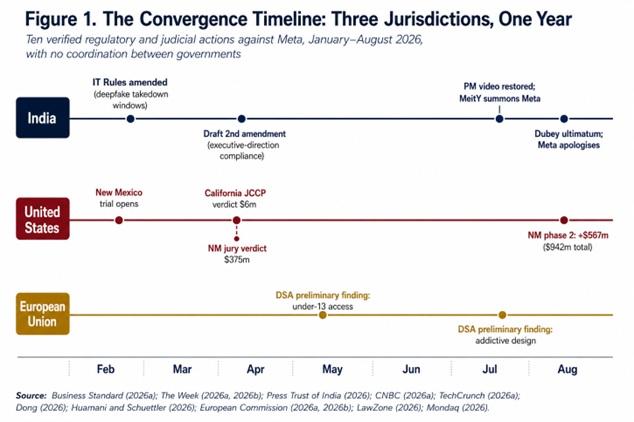
Figure 1. Ten verified actions, three jurisdictions, no coordination between them — see Part I.
Part II. Why "Safe Harbour" Stopped Being a Safe Answer
Both sides of the Pacific built the same foundational bargain: immunity purchased with passivity. Section 230 of the US Communications Decency Act shields platforms from liability for what users post (United States Congress 1996). Section 79 of India's Information Technology Act, 2000 is structurally similar, conditioned on a platform acting against unlawful content once notified (Government of India 2000). Both statutes picture a noticeboard. Neither anticipated a recommendation engine deciding, several billion times a day, which sliver of the world any given person actually sees.
That the noticeboard analogy has broken down is, by 2026, an unremarkable claim. More interesting is the specific mechanism of its collapse, which owes less to legislative reform than to doctrinal self-sabotage. In 2024 the US Supreme Court, in Moody v. NetChoice, sided with platforms resisting state must-carry laws, holding that when a platform compiles and arranges other people's speech, the compilation itself is the platform's own "expressive product" — protected, like an editor's front page, by the First Amendment (Moody v. NetChoice, LLC 2024). Industry counsel wanted exactly this outcome. What they got, within weeks, was its inversion. The Third Circuit, in Anderson v. TikTok, turned the same premise around: if algorithmic curation counts as the platform's own speech for First Amendment purposes, it cannot simultaneously count as someone else's content for Section 230's third-party shield. TikTok's promotion of a fatal "Blackout Challenge" video to a ten-year-old user was not automatically immune (Anderson v. TikTok, Inc. 2024). The industry had argued its way into editorial responsibility to escape one regulation, only to find the same argument turned against it in another. Not every scholar finds the syllogism sound — critics call it a stretch of Moody's dicta into a doctrine never built to bear the weight (Techdirt 2024), while others accept the result and distrust the reasoning that produced it (EPIC 2024). Contested logic, uncontested direction: every ruling examined in this paper has moved the same way since.
India's parliamentary committee reached a blunter version of the same insight without the constitutional machinery. Conveyed to Meta directly, in terms closer to an ultimatum than a legal opinion: a platform whose own systems decide who receives which content is functioning as a publisher, not an intermediary, and safe harbour follows the latter, not the former (Press Trust of India 2026). A cruder instrument than a circuit court's opinion. Possibly, in its bluntness, the more honest one.
Part III. Five Layers, Three Governments
Treat "platform responsibility" as one undifferentiated idea and the debate stalls at the level of slogans. Break it apart — what a user makes, how it moves, what the platform builds around it, how it is monetised, what the system does in aggregate — and each layer turns out to be contested by a different actor, on different legal grounds, with different odds of survival. Figure 2 sketches the pipeline this section walks through; Table 1 names the five layers.
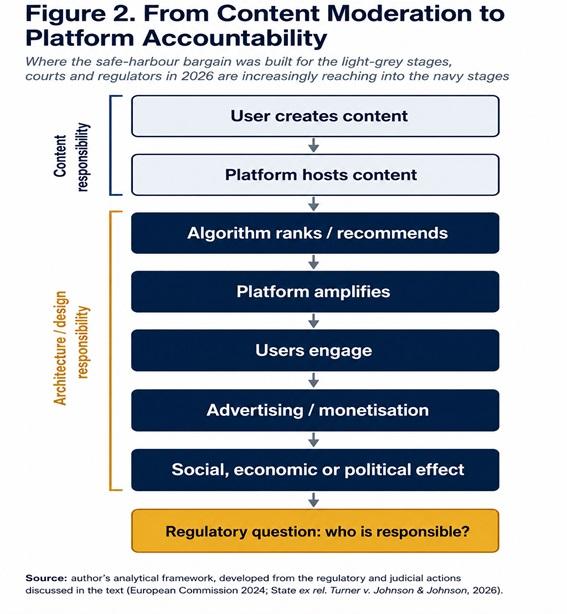
Figure 2. The safe-harbour bargain covered hosting; 2026's rulings increasingly reach into ranking, amplification and monetisation.
Table 1. Five Layers of Platform Responsibility
|
Layer |
What It Covers |
2026 Evidence (This Paper) |
|
Content responsibility |
What a user creates or uploads |
Undisputed baseline; not contested in any case surveyed in this paper |
|
Distribution responsibility |
How content is ranked, recommended or amplified |
Anderson v. TikTok; New Mexico's bar on recommending minors' accounts to adults |
|
Design responsibility |
Features deliberately built into the product |
California's infinite-scroll ruling; New Mexico's screen-time and like-count mandate; EU addictive-design finding |
|
Monetisation responsibility |
Advertising, paid promotion, commercial incentives |
India committee's advertising questions to Meta; the broadcaster analogy |
|
Systemic responsibility |
Cumulative effect of architecture at platform scale |
EU's systemic-risk framework under the DSA; India's executive-liability precedent |
Source: author's analytical framework, developed from evidence discussed in this paper (not an established academic taxonomy).
Content responsibility is, notably, the layer nothing in this paper's evidence actually contests. No court, regulator or parliamentary committee examined here has argued Meta should answer for a user's words merely for hosting them. That baseline holds throughout 2026. Everything that follows is what has come apart on top of it.
Distribution responsibility — how content is ranked, recommended or amplified to a given user — is where the first serious crack opened, and Anderson is the clearest instance: a recommendation is not the same act as hosting, whatever the underlying content. New Mexico's design decree makes the same point operationally rather than doctrinally, barring Meta from recommending minors' accounts to adults with whom they have no connection (Huamani and Schuettler 2026). Two institutions, one conclusion: who gets shown to whom is a decision the platform makes, not a fact about the content itself.
Design responsibility — features deliberately built into the product, independent of any specific recommendation — is where 2026's remedies have bitten hardest. A Los Angeles jury awarded $6 million against Meta and Google in a bellwether verdict in March, Meta carrying seventy percent of the liability; the trial court had already ruled that Section 230 does not reach claims about infinite scroll or engagement-optimised notification timing, as distinct from claims about content (Dong 2026; Clyde & Co 2026). New Mexico's own decree adds hidden "like" counts, a ninety-hour monthly cap for minors, and — drawing on testimony about how encrypting Messenger by default in 2019 curtailed Meta's ability to act on some 7.5 million child-exploitation reports — stronger review obligations (CNBC 2026a; TechCrunch 2026a). Brussels reached the same layer through its own preliminary finding that the "addictive design" of Instagram and Facebook independently breaches the Digital Services Act (European Commission 2026b). None of this is settled law. Nuisance theory has a poor record surviving appeal once stretched past physical encroachment — in 2021 the Oklahoma Supreme Court, five to one, threw out a comparable $465 million verdict against Johnson & Johnson on the ground that the state's nuisance statute did not extend to a lawful product's manufacture and sale (State ex rel. Hunter v. Johnson & Johnson 2021) — and if platforms succeed in recasting design as protected editorial speech, the very move Moody invites, a theory that survives state law could still be gutted on First Amendment grounds. A verdict is not a doctrine; on this layer, 2026 may be an opening bid rather than a conclusion.
Monetisation responsibility is the layer India's own committee pressed hardest, and the one American litigation has barely reached. Committee members asked Meta directly why sexually exploitative material reportedly persisted on the platforms while a head-of-state's video vanished within hours of an automated flag (The Week 2026b) — a question about incentives, not capability. Chart 1 shows why the incentives are worth asking about: Meta's capital spending, overwhelmingly funded by an advertising business that generated nearly $201 billion in 2025 revenue, has more than quadrupled since 2023 (Meta Platforms, Inc. 2026a). A landlord collects rent regardless of what a tenant says. A platform that also decides who hears the tenant, and prices the audience assembled around them, sits closer to a broadcaster — and broadcasters, not coincidentally, have never enjoyed anything resembling Section 230's immunity.
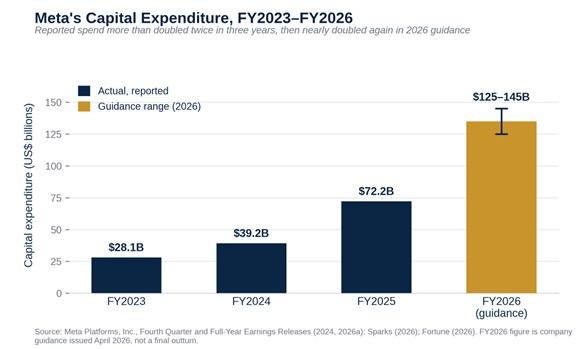
Chart 1. Meta's AI-driven capital spending has escalated even as litigation costs mount — see Part III and VI.
Systemic responsibility — harm arising from the cumulative architecture, not any single design choice — is the only layer any government has tried to regulate before the fact rather than after it. The Digital Services Act treats Meta's platforms as systemic-risk managers with affirmative duties to assess harm; the Commission's preliminary finding that ten to twelve percent of under-13s use Instagram and Facebook regardless of the stated minimum age is a systemic claim, not a design or content one (European Commission 2026a). India's willingness to name a platform executive personally in the Hyderabad case reaches for the same idea by cruder means — enforcement aimed past any single post toward whoever is answerable for the system as a whole. The scale under discussion is not abstract: by Meta's own advertising-audience data, India is Instagram's single largest national market (DataReportal 2026).
Why do three governments, converging on the same five layers, do it through such different institutions? Constitutional culture supplies most of the answer. America's First Amendment tradition makes legislating platform design directly close to impossible, so the work falls to courts drawing fine, contestable distinctions case by case — incrementalism, not design, and whether the resulting slivers survive appellate review in aggregate is genuinely unresolved. The EU's administrative and precautionary tradition makes ex ante systemic-risk regulation the obvious tool: Brussels regulates the probability of harm, not merely its occurrence, backed by fines of up to six percent of global turnover — north of $12 billion on 2025 revenue, though rarely levied at that ceiling in practice, since DSA proceedings routinely resolve through negotiated commitments (Business Standard 2026c; European Commission 2026a). India's executive-heavy state, where a parliamentary committee can extract a public apology within seventy-two hours unlike any Western legislature, makes rapid, discretionary, personalised pressure the default lever — for better and for worse, a distinction the next section takes seriously. Table 2 lays the three regimes side by side.
Table 2. From Intermediary Protection to Platform Accountability
|
Dimension |
India |
United States |
European Union |
|
Governing instrument |
IT Act, 2000, §79, plus executive rule-making |
Communications Decency Act, 1996, §230 |
Digital Services Act, 2022 (in force 2024) |
|
Core logic |
Conditional safe harbour tied to due diligence and takedown compliance |
Broad immunity for third-party content; no statutory design carve-out |
Ex ante duty to assess and mitigate “systemic risk” for the largest platforms |
|
Mechanism of change |
Executive rule-making — IT Rules amendments, Feb. and Mar. 2026 |
Case-by-case judicial reinterpretation — Anderson v. TikTok (2024) |
Direct legislative and regulatory design mandate |
|
2026 action against Meta |
Criminal FIR naming Meta India’s MD over AI-generated content; parliamentary ultimatum |
New Mexico: $942m + five-year design decree. California JCCP: $6m bellwether verdict |
Two preliminary DSA breach findings — under-13 access; addictive design |
|
Maximum exposure / leverage |
Discretionary loss of safe harbour, per committee threat |
Case-by-case damages; no statutory cap |
Up to 6% of global annual turnover (˜$12bn on 2025 revenue) |
|
Primary institutional actor |
Executive ministry, parliamentary committee, police |
State attorneys general and civil juries |
European Commission |
Source: compiled by author from Government of India (2000); United States Congress (1996); Anderson v. TikTok, Inc. (2024); European Commission (2026a, 2026b); The Week (2026a); TechCrunch (2026a); Dong (2026); LawZone (2026); Mondaq (2026); Business Standard (2026c). See Part III and References.
Part IV. Delhi's Complication
Return to Delhi, because the Indian case carries a wrinkle the five-layer taxonomy does not resolve on its own.
Meta's own account of the prime minister's video was a filtering error, not a government takedown order — architecture malfunctioning, on this telling, rather than a state actor censoring anyone. The government's response nonetheless included a criminal case against a named executive and a parliamentary ultimatum questioning, in essence, whether Meta counts as an intermediary at all (The Week 2026a; The Week 2026b). Weighed against Parts II and III, that response is not unreasonable on its face. A company separately accused — including by its own parliamentary interlocutors — of tolerating CSAM and non-consensual content while a single high-profile post disappeared within hours has invited exactly this kind of scrutiny (The Week 2026b). Judged purely by the accountability logic this paper has been building, India's posture reads as more consistent, not less, than treating the two failures as unrelated.
Stopping the analysis there would be a failure of nerve, not rigor. A state that can extract a personal apology from a foreign chief executive inside seventy-two hours, and that frames the underlying legal question as whether a platform's discretion over political content forfeits its immunity, has built itself real leverage over what political speech survives on that platform — leverage a company headquartered eight thousand miles away has limited capacity to resist, whichever government happens to be exercising it, whichever content is at issue. Both risks this paper has documented are genuine, and they do not net out to zero. A platform that polices itself risks becoming an unaccountable arbiter of political speech. A government that polices the platform risks the identical outcome, with less transparency about how the decision was reached and considerably more coercive apparatus behind it. Holding both findings at once, rather than resolving the tension in whichever direction happens to be more comfortable, is the only honest way to write this section — for an Indian readership or any other.
Part V. What the Skeptics Get Right
None of the foregoing should curdle into a reflexive assumption that more liability is automatically better policy. Platforms' defenders have arguments worth taking seriously, not waving off.
Billions of posts a day cannot be manually reviewed by anyone, and ranking is how users navigate abundance that would otherwise be unusable, not evidence of a conspiracy against them. Design liability, applied without discipline, risks pushing platforms toward over-removal — erring on the side of caution is cheaper than defending individual judgment calls in court, and that incentive burdens ordinary speech far more than it burdens genuinely harmful design. One legal commentator has anticipated the industry's next move: having lost the Section 230 shield in design cases partly because of the First Amendment reasoning in Moody, platforms may soon invoke that same reasoning offensively, arguing algorithmic ranking decisions are themselves protected editorial speech immune from second-guessing by courts or legislatures (Techdirt 2024). Should that argument succeed, the net effect of two years of jurisprudence would be to entrench platform discretion rather than constrain it — the opposite of what child-safety advocates currently expect from it.
There is also a fragmentation cost the five-layer framework risks obscuring by making convergence look tidier than it is. A single global recommendation system cannot simultaneously satisfy a New Mexico decree barring adult-to-minor account recommendations, a Digital Services Act transparency-and-opt-out regime built on a different legal premise, and whatever India's parliamentary committee decides "publisher, not intermediary" requires in practice. Five layers, one taxonomy, but three governments filling in the boxes with incompatible rules. A New Mexico penalty, a California jury verdict and a Brussels regulatory finding are three different legal instruments, resting on different law, different appellate pathways, different odds of survival — and India's FIR against a named executive is barely commensurable with any of them, since it has not yet produced so much as a formal chargesheet. Treating all four as one unified "platform accountability" story, rather than as four unfinished experiments running in parallel with uncertain, possibly contradictory outcomes, overstates how settled any of this actually is.
What the framework offers, at its most defensible, is not a mandate for blanket liability but a narrower question to replace a cruder one: not whether a platform hosted something harmful — an almost unanswerable question at internet scale — but which layer, specifically, it built something that made the harm more likely, more visible, or more profitable. Narrower than either side of this debate usually wants. On the evidence assembled here, the narrower claims are also the ones currently surviving contact with courts.
Part VI. Three Ways This Could Go
Three trajectories look plausible from here. Nothing currently visible picks decisively among them.
Convergence: courts and regulators keep treating architecture as the natural next liability frontier — most of 2026's rulings point this way — and the five-layer distinction hardens into something resembling settled doctrine across jurisdictions that otherwise share almost nothing.
Fragmentation: India's executive-led and increasingly criminal model, America's slow common-law patchwork, and Europe's ex ante systemic-risk regime instead harden into incompatible compliance regimes, forcing one global product to fork into several jurisdictionally specific versions of itself. Every party to this debate claims to want to avoid that outcome. Nothing currently visible is doing much to prevent it.
Adaptation: Meta pre-empts the dilemma altogether, exporting New Mexico's screen-time limits or Brussels-driven design changes worldwide rather than confining them to the jurisdictions that compelled them — not from principle, but because a single conservative global default is cheaper to maintain than fifty separate rule sets. Earlier regulated industries absorbed compliance costs this way once fragmentation became the pricier option; there is no obvious reason platforms would behave differently.
Which path dominates depends less on any single verdict, however dramatic, than on a narrower and more mundane question: whether Meta's internal calculus treats each jurisdiction's demands as a local cost to be managed in isolation, or as a signal about where the whole product eventually has to move.
Coda
The algorithm is not neutral — not because it operates independently of the company that built it, which would be the more dramatic and less accurate claim, but because ranking, recommending and pricing attention are ordinary business choices with an identifiable author, layer by layer. What 2026 has clarified, from Santa Fe to Brussels to Hyderabad, is that the frontier of Big Tech accountability is moving from what platforms allow to what their architecture makes visible, discoverable and profitable. States with almost nothing else in common — a common-law federation, a supranational regulator, a parliamentary democracy governing substantially by executive circular — have each, independently, through their own institutional idiom, arrived at some version of the same suspicion. That convergence, not any single verdict, is the more durable story.
References
Anderson v. TikTok, Inc. 2024. No. 22-3061 (3d Cir., August 27).
Business Standard. 2026a. "IT Ministry Summons Meta over Deletion of PM Modi's Video on Facebook." Business Standard, July 28. https://www.business-standard.com/india-news/meta-restores-pm-modi-s-video-on-facebook-says-removed-by-error-126072800526_1.html.
Business Standard. 2026c. "EU Says Meta's Safeguards Fail to Stop Under-13 Users on FB, Instagram." Business Standard, April 30. https://www.business-standard.com/technology/tech-news/eu-preliminary-finding-investigation-meta-safeguard-fail-to-stop-under-13-users-fb-instagram-fine-dsa-126043000726_1.html.
Clyde & Co. 2026. "Navigating the First-Instance Judgments in Social Media Addiction Litigation." Clyde & Co Insights, April 10. https://www.clydeco.com/en/insights/2026/april/navigating-the-first-instance-judgments-in-social.
CNBC. 2026a. "Meta Must Pay $375 Million for Violating New Mexico Law in Child Exploitation Case, Jury Rules." CNBC, March 24. https://www.cnbc.com/2026/03/24/jury-reaches-verdict-in-meta-child-safety-trial-in-new-mexico.html.
CNBC. 2026b. "Meta's Public Nuisance Case in New Mexico Has Billion-Dollar Consequences." CNBC, May 4. https://www.cnbc.com/2026/05/04/meta-new-mexico-child-safety-facebook-instagram.html.
DataReportal. 2026. "Digital 2026: India." DataReportal – Global Digital Insights. https://datareportal.com/reports/digital-2026-india.
Dong, Shanshan. 2026. "Jury Finds Meta and YouTube Negligent in Landmark Lawsuit on Social Media Safety." NBC News, March 25. https://www.aol.com/articles/verdict-reached-landmark-social-media-165304806.html.
EPIC (Electronic Privacy Information Center). 2024. "In Anderson v. TikTok, the Third Circuit Applies Questionable First Amendment Reasoning to Arrive at the Correct Section 230 Outcome." EPIC, October 10. https://epic.org/in-anderson-v-tiktok-the-third-circuit-applies-questionable-first-amendment-reasoning-to-arrive-at-the-correct-section-230-outcome/.
European Commission. 2026a. "Commission Preliminarily Finds Meta in Breach of Digital Services Act for Failing to Prevent Minors Under 13 from Using Instagram and Facebook." Press release IP/26/920, April 29. https://ec.europa.eu/commission/presscorner/detail/en/ip_26_920.
European Commission. 2026b. "Commission Preliminarily Finds the Addictive Design of Instagram and Facebook in Breach of the Digital Services Act." Press release IP/26/1579, July 10. https://ec.europa.eu/commission/presscorner/detail/en/ip_26_1579.
Fortune. 2026. "Meta Just Bumped Its 2026 Capex Forecast Up to as Much as $145 Billion for the AI Boom — and Investors Flinched." Fortune, April 29. https://fortune.com/2026/04/29/meta-zuckerberg-145-billion-ai-spending-roi/.
Government of India. 2000. The Information Technology Act, 2000. Section 79.
Huamani, Kaitlyn, and Mikella Schuettler. 2026. "A New Mexico Judge Ordered New Child Safeguards for Meta. Advocates Hope Other Courts Follow." Associated Press, August 8. https://www.wokv.com/news/business/new-mexico-judge/UYPQASKPHE3NFHUD6SIU2Z6DOY/.
LawZone. 2026. "IT Rules 2026: India's Digital Governance Revolution." Law Zone – The Indian Legal Education Portal, July. https://www.lawzone.in/2026/08/it-act.html.
MDL Update. 2026. "Social Media Addiction Lawsuit Update July 2026: TikTok & Snap Settle, $6M Meta Verdict." MDLUpdate.com, July 1. https://mdlupdate.com/mdl/3047-social-media-adolescent-addiction/.
Meta Platforms, Inc. 2024. "Meta Reports Fourth Quarter and Full Year 2023 Results." Press release. https://s21.q4cdn.com/399680738/files/doc_financials/2023/q4/Meta-12-31-2023-Exhibit-99-1-FINAL.pdf.
Meta Platforms, Inc. 2026a. "Meta Reports Fourth Quarter and Full Year 2025 Results." Press release, January 28. https://investor.atmeta.com/investor-news/press-release-details/2026/Meta-Reports-Fourth-Quarter-and-Full-Year-2025-Results/default.aspx.
Mondaq. 2026. "From Safe Harbour to Command-and-Control: How India's 2026 IT Rules Draft Turns Intermediary Compliance into Real-Time Obedience." Mondaq, April 14. https://www.mondaq.com/india/social-media/1773046/from-safe-harbour-to-commandandcontrol-how-indias-2026-it-rules-draft-turns-intermediary-compliance-into-realtime-obedience.
Moody v. NetChoice, LLC. 2024. 144 S. Ct. 2383.
Press Trust of India. 2026. "Meta under Fire over Content Manipulation: Zuckerberg Apologises over PM Modi Video Row, CSAM, Deepfake Lapses." Reproduced in Organiser, August 5. https://organiser.org/2026/08/05/373662/bharat/meta-under-fire-over-content-manipulation-mark-zuckerberg-apologises-over-pm-modi-video-row-csam-deepfake-lapses/.
Sparks, Daniel. 2026. "Meta Platforms Is on a Spending Spree — and It's Massive. Here's Some Telling Perspective." The Motley Fool, via AOL Finance. https://www.aol.com/finance/meta-platforms-spending-spree-massive-182300649.html.
State ex rel. Hunter v. Johnson & Johnson. 2021. 2021 OK 54 (Oklahoma Supreme Court, November 9).
Techdirt. 2024. "The Third Circuit's Section 230 Decision in Anderson v. TikTok Is Pure Poppycock." Techdirt, September 3. https://www.techdirt.com/2024/09/03/the-third-circuits-section-230-decision-in-anderson-v-tiktok-is-pure-poppycock/.
TechCrunch. 2026a. "New Mexico Court Orders Meta to Pay Additional $567M in Child Safety Case." TechCrunch, August 7. https://techcrunch.com/2026/08/07/new-mexico-court-orders-meta-to-pay-additional-567m-in-child-safety-case/.
TechPolicy.Press. 2026a. "Why New Mexico v. Meta Matters." TechPolicy.Press, August 7. https://www.techpolicy.press/why-new-mexico-v-meta-matters/.
The Week. 2026a. "Telangana Govt Shifts DCP Who Filed Case on Meta India Chief." The Week, August 1. https://www.theweek.in/news/india/2026/08/01/hyderabad-cyber-crime-meta-india-fir.html.
The Week. 2026b. "'Zuckerberg Should Personally Apologise': IT Panel Chief over Removal of PM Modi's Video." The Week, August 4. https://www.theweek.in/news/india/2026/08/04/zuckerberg-apology-modi-video-meta-nishikant-dubey.html.
United States Congress. 1996. Communications Decency Act. 47 U.S.C. § 230.
Funding: No funding was received for this research.
Conflict of Interest: The author declares no conflict of interest.
(Author’s Bio: Vikas Bhardwaj is a scholar of international political economy, holding a Ph.D. and M.Phil. from the Centre for Russian and Central Asian Studies, School of International Studies, Jawaharlal Nehru University (JNU), New Delhi. His work focuses on economic statecraft, sanctions, energy geopolitics, and global economic governance.
He has worked as a researcher with numerous institutions, including the Indian Institute of Public Administration (IIPA), contributing to multiple policy evaluation projects commissioned by the Government of India Ministries. Bhardwaj holds nine academic degrees and has published in international peer-reviewed journals on the Russian economy, geopolitical conflict, and shifting global power dynamics.)
| Comments in Chronological order (0 total comments) | |
| Report Abuse |
| Contact Us | About Us | Donate | Terms & Conditions |


|
All Rights Reserved. Copyright 2002 - 2026