| Tue. March 10, 2026 |
 |
|
||
|
||||
| ||||


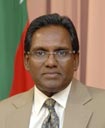 International Affairs Forum: As an island nation the consequences of climate change, with respect to rising water levels will be particularly direct for Maldives. The cabinet met underwater sometime ago to publicize this grim reality to the world, and Maldives has set an ambitious agenda to drastically reduce its own greenhouse gas (GHG) emissions. But without a global deal on climate change, there is little Maldives can do to avert what seems like a disaster. What are your expectations from Copenhagen?
Dr. Mohammed Waheed: We expect all nations to exercise their global obligations and agree on a deal that is ambitious enough to save the planet, especially low lying islands and other most vulnerable countries. We expect the deal to be a binding treaty, but that looks too optimistic. There are still disagreements regarding the GHG emission cuts.
Small Island Developing countries are demanding a reduction of peak emission levels to 350 ppm (parts per million) and global climate warming of not more than 1.5 degrees. We must find language that will urge developed countries and the BRICs to aim at 1.5 not 2 degrees. We expect developed countries to make firm financial commitments especially for adaptation and to earmark funds for the most vulnerable countries.
It would be a great shame if we are not able to reach any agreement in Copenhagen. It would be such a huge waste of human energy and financial resources. Future generations will not forgive us.
IA-Forum:: Maldives as mentioned earlier has an ambitious agenda to reduce GHG emissions, by initiating zero use of fossil fuels by 2020 among other policies. How are you going to accomplish this task? What are some other key features of your agenda to combat GHG emissions? Can other developed and developing countries learn from your policies?
Dr. Waheed: Here in Maldives we have made a political commitment to follow a low carbon development path leading to carbon neutrality within 10 years. This is quite possible through a coordinated national plan of action involving public-private partnerships.
We will provide special incentives to the largest economic sector which is tourism to adopt clean technologies and renewable energy sources. All government supported projects will have a clean tech component. We will progressively reduce our reliance on fossil fuels and introduce wind and solar energy. We will promote carbon capture and storage and introduce offsetting mechanisms to compensate for emissions in the transport sector. We have floated the idea of low carbon growth to other like minded countries among the “frontline states” on global warming. The idea is catching on and we hope that many more countries will adopt a low carbon development model.
IA-Forum: What sort of financing is necessary - from the external and domestic side - to help implement Maldives' ambitious GHG emissions reduction agenda?
Dr. Waheed: Maldives needs to invest about 100 million dollars in renewable energy every year for about 10 years. But the savings from fossil fuel will be enough to recover this investment in not more than 20 years. We are exploring PPP arrangements, including joint venture partnerships for electricity generation, waste management and production of water. We are also arranging credit facilities to the tourism sector to make greater investments in clean tech.
IA-Forum: You say that the G8 commitment to not let global temperatures rise above 2 degrees celsius is woefully inadequate and want a 1.5 degree Celsius goal. What sort of commitment from developed countries would this entail, and how much finance/technology transfer would be needed for developing countries, to attain such a target?
Dr. Waheed: Already there is a proposal from the British Prime Minister, Gordon Brown to create a 10 billion dollar fund per annum fund to help developing countries achieve carbon mitigation and adaptation. We understand that a significant amount of this would be available to the most vulnerable countries.
The amount of funds that will be required for adaptation is directly linked to GHG emission levels. If the agreement reaches a 2 degree level, then the amount of money needed for adaptation and disaster prevention and management would be much higher than the 1.5 degrees that we are advocating for.
IA-Forum: How would you try to bridge seemingly irreconcilable differences between large emerging economies, like China and India, and the developed economies of Europe and America, when it comes to climate change?
Dr. Waheed: Both China and India have been forthcoming with proposals that indicate their desire to achieve agreement with developed countries. Some of the developed countries themselves have shown great willingness. A lot depends on the language but all of this is still falling short of what we need for countries like Maldives.
IA-Forum: If you were advising developed country leaders - say, President Obama asked you what US policy should be - with regards to island nations' concerns on climate change, what would be your advice?
Dr. Waheed: First of all, we need to appreciate the initiative of the US President to aim at higher GHG emission cuts than the previous administration. We were also pleasantly surprised by the new prime Minister of Japan who has announced very ambitious goals. We would request leaders of developed nations to insist on the value of small islands and the importance of preserving archipelagos as part of the global heritage. We also want them to value the survival of the people of small island nations as a symbol of their respect for human rights everywhere.
IA-Forum: Do you know of a particular developed country (/countries) that has a climate change policy agenda, which takes the concerns of developing countries seriously and has effective ways to incorporate these concerns?
Dr. Waheed: I believe that there is good intention. I am happy that many countries such as Japan, China and the EU are taking our concerns very seriously.
IA-Forum: Finally, what do you think is the most likely outcome at Copenhagen?
Dr. Waheed: I think Copenhagen will achieve a political agreement reflecting a compromise solution. We may not be able to achieve what we want now but I expect that the 15th Conference of Parties (COP) will give a mandate for an early adoption of a legally binding document during 2010.
Dr. Mohamed Waheed is the Vice President of Maldives. He has spent a number of decades serving Maldives as a policy-maker and legislator, and is one of the most influential thinkers of the island nation. Dr. Waheed has also held high level positions at the United Nations, with the UNESCO, UNIDO and UNICEF – most recently in Afghanistan as the UN Special Representative for Education and as the head of the UNICEF there. He received his PhD from Stanford University.
| Comments in Chronological order (7 total comments) | |
| Report Abuse |
|
|
| One doesn't necessarily think of small island nations such as Maldives, when we consider developing country views on climate change. It is interesting to observe how the very survival of the country is at stake and how this has led to the creation of dramatically effective policies in Maldives, as VP Waheed mentions here. | |
|
|
| Perhaps, Mrs. Palin should be sent to Maldives to see what the effects of climate change truly are. | |
|
|
| The emerging deal on climate change now surely seems to be going for a temp increase that is above 2 degrees. That's a pity for the people of Maldives. | |
|
|
| Maldives may lose and so would many island nations, but would not there be gains of greater magnitude for large developing nations and their billions of citizens? From a utilitarian perspective, the compromise solution at cop15 may be better. | |
|
|
| But what of all those that will suffer the consequences of being drowned or having to leave their homelands. Utilitarian perspectives are not the only ones to judge the justness of an action | |
|
|
| EU always claims they are the pioneers in fighting climate change. If you scrutinize their policy after Kyoto meeting, We can find they only pay lip service. We hardly ever heard of EU's financial support to developing world,seldom heared of their ambitious GHG-cutting plan put into action.
EU can blame Kyoto protocol's failure to US's absence, Obama can blame the failure to his predecessor (G.W.Bushand) , US senate and developing world. My advice to Obama is: if US government think emerging powers's porposals of reducing 40%-45% GHG emission per GDP income by 2020, make it clear to the developing world , what US can do now? Do we need to prompt Obama that US GHG emmission per capita are quadruple to China and 15 times to India. |
|
|
|
| I appreciate what is being said about the Maldives. But as for developing contries, I think that its about time for them to be more responsible.We cannot look at the past and continue to say that developed nations abused the earth-that would be a wrong attitude.Developing countries must be responsible like good global citizens.If otherwise, politicains will abuse the situation.In Sarawak, the CMinister is a billionaire with monies lodged in Canada-thanks to his vision of developing Malaysia.What in fact happens is that land is being levelled so that his cronies can plant oil palm or Dams are being built so that logging companies can collct timber.Its been 10 years since the logs have been felled,but the Bakun Dam is a WIP! | |
| Contact Us | About Us | Donate | Terms & Conditions |


|
All Rights Reserved. Copyright 2002 - 2026