| Thu. April 16, 2026 | |

|
|
|
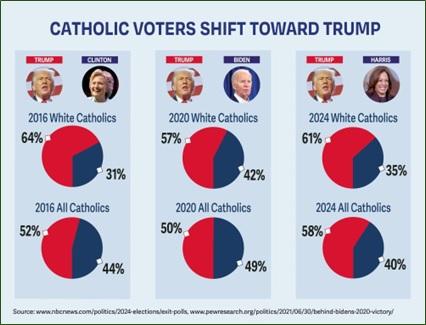
By Professor Manlio Graziano Joseph Nye has highlighted the importance of soft power, that is, the ability to exert influence through persuasion and moral authority rather than material force. Years before Nye formulated this concept, however, a striking practical example was provided by none other than Josef Goebbels. In 1943, the Reich’s Minister of Propaganda reportedly dissuaded Hitler from taking military action against the Vatican, arguing that such a move would have had a devastating impact on world opinion (and on German Catholics). The Wehrmacht, which had ruthlessly trampled the borders of all of Europe, thus stopped short of the defenseless Leonine Walls. What the former Orthodox seminarian Iosif Džugašvili, A.K.A. Stalin, failed to grasp was, conversely, crystal clear to the Bavarian Catholic Josef Goebbels, a graduate of the religious lycée in Rheydt. Any detective novel rests on the premise that one may be a criminal without necessarily being stupid. Joseph Goebbels was undoubtedly one of the worst criminals of the twentieth century, but he was not stupid. Today, by contrast, the American administration seems to demonstrate to the whole world that one can be both criminal and stupid at the same time. Among the factors that must be considered in analyzing international politics — alongside geography, economics, demography, history, institutions, etc. — Nicholas Spykman also included what he called “the complexes and petty prejudices of foreign ministers,” that is, their personal, moral, and other shortcomings. He concluded that it is the “simultaneous action and interaction” of all these factors that shapes “that complex phenomenon known as ‘foreign policy.’” This lesson is very much relevant today. It is true that there is still a gap between “complexes and prejudices,” however petty, and outright stupidity; yet the underlying principle is clear: the stupidity of those in positions of political responsibility is a factor that must be taken into account, alongside other intangible and immeasurable elements such as social psychology, historical legacy, identity, and even chance. The stupidity of those in positions of political responsibility, however, is not a matter of chance but of circumstance; and, as far as the current members of the U.S. administration are concerned, it is also measurable. Donald Trump cannot be separated from the 77 million Americans who voted for him on November 5, 2024, fully aware of who he was. Those 77 million voters chose him because they felt disoriented and unsettled by their country’s perceived decline — an experience reflected in everyday concerns such as access to healthcare, the cost of higher education, grocery prices, fuel, housing, and more. These are areas in which, in the past, Americans used to enjoy advantages unmatched elsewhere in the world. Faced with this sense of loss, many have responded with anxiety and resentment, embracing the idea of making America great again by exerting revenge on the rest of the world, guilty of having taken advantage of American generosity. It is therefore essential to restate a fundamental point: Donald Trump is not the creator of this dominant social psychology, but he is its product. *** Having clarified the respective responsibilities, let us return to the specific case: the feud between the president of the world’s most powerful country and the head of the world’s most influential political-religious organization, both Americans, both Republicans. Under normal circumstances, there should be no conflict between them. Yet the former has repeatedly shown that he rarely has even the faintest grasp of what he is talking about, while the latter, the moment he ascends to the throne of St. Peter, ceases to be American (and even more so, to be a Republican). The facts are well known: in January, Robert Prevost—who last spring became head of the global Catholic Church under the name Leo XIV—spoke in unusually explicit terms during a meeting with the diplomatic corps accredited to the Vatican, stating that «a diplomacy that promotes dialogue is being replaced by a diplomacy based on force… War is back in vogue and a zeal for war is spreading… Peace is sought through weapons as a condition for asserting one’s own dominion.” Faced with such impudence, and accustomed as they are to displays of flattery as abundant as they are undignified, officials in Washington lost patience. The Apostolic Nuncio (Holy See’s ambassador) to the United States, Cardinal Christophe Pierre, was “summoned” to the Pentagon, headquarters of the Department of Defense, renamed Department of War since war-junkie Pete Hegseth took office. According to reports cited by Mattia Ferraresi, Undersecretary Elbridge Colby allegedly delivered “a bitter lecture warning that the United States has the military power to do whatever it wants, and that the Church had better take its side.” At this point, a reference was reportedly made to the so-called Avignon Papacy, the period from 1309 to 1377 during which the popes relocated the seat of the Catholic Church to Avignon, where they could be kept under the control of the King of France (and where they could control him). Colby’s implicit threat has neither been confirmed nor denied by either side. In any case, Cardinal Pierre, a native of Brittany, the most Catholic region of France, would have been well aware of the historical reference. It is nonetheless curious that Colby, who is by no means ill-informed, should have invoked King Philip the Fair rather than Napoleon, who in fact had two popes abducted: Pius VI in 1798 and Pius VII in 1809, both taken into captivity by French forces, in a manner not unlike the American abduction of Nicolás Maduro. Whatever the tone of the exchange may have been (other Catholic sources described it as “frank,” which, in diplomatic language, usually means that no restraint was exercised), the situation has only deteriorated since then. During the Palm Sunday celebration in March, Leo XIV doubled down, declaring that “Jesus does not listen to prayers of those who wage war,” an implicit, though scarcely subtle, reference to the war-junkie Pete Hegseth, who has infused his pronouncements from the Pentagon with a quasi-religious, crusading rhetoric. Not coincidentally, among the many tattoos covering his alpha-male body is a prominent Deus vult, the rallying cry of the First Crusade, and his book bears the telling title American Crusade. In the days leading up to Easter, Pete Hegseth circulated an email stating: “There will be a Protestant Service (No Catholic Mass) for Good Friday today at the Pentagon Chapell.” A department employee reportedly commented, “I guess so the Catholics know their kind ain’t welcome.” Speaking at the White House on Palm Sunday, Donald Trump recalled that on that day “Jesus entered Jerusalem as crowds welcomed him with praise honoring him as king,” before adding, with a mischievous smile, “They call me king now. Can you believe it?” (the video was later removed from the White House website). At the same event, the evangelical pastor Paula White-Cain, head of the White House Office of Faith, declared: “Mr. President… you were betrayed and arrested and falsely accused. It’s a familiar pattern that our lord and savior showed us. But it didn’t end there for him, and it didn’t end there for you.” On Easter Sunday, as is well known, the president threatened to wipe out “an entire civilization” in a single day, a statement the pope described as “truly unacceptable,” not only because it violates international law, but because it violates fundamental moral principles. Then, on April 11, during a homily, the pope denounced the “delusion of omnipotence” and called for an end to the “demonic cycle of evil.” He went on to declare: “Enough of the idolatry of self and money! Enough of the display of power! Enough of war!” He did not mention Donald Trump by name, as some were quick to note; yet it requires little exegetic skills to grasp the intended target. Indeed, “the self,” “money,” “the display of power,” and “war” appear, in that order, to define the only Trump’s concerns, and which, in fact, he idolizes. At that point, Donald Trump’s fury boiled over. On April 13, he published a 334-word post in which he claimed, among other things, that Leo XIII was “weak on crime and terrible on foreign policy… He thinks it’s OK for Iran to have nuclear weapons.” He went on to declare: “I don’t want a pope who criticizes the President of the United States,” and even asserted that the pontiff owed his election to him: “If I weren’t in the White House, Leo wouldn’t be in the Vatican.” In short, “Leo should get his act together as pope, use common sense, and stop pandering to the radical left.” He concluded bluntly: “He is damaging the Catholic Church!” Shortly thereafter, he doubled down, declaring that Leo “likes crime” and that he is “a very liberal person” (it is worth recalling that, in the American political language, “liberal” spans a broad spectrum, from moderate center-left to the far left). He then posted the now widely circulated AI-generated image depicting himself as Jesus, healing the sick. The post was later removed following outraged reactions from some of his own evangelical supporters. Trump, in turn, dismissed the episode by claiming that it had been fabricated by “the fake news media,” and insisted that the image in fact portrayed him as “a doctor” curing the ills of America. The final episode in this account — which grows increasingly tedious — is Leo XIV’s statement, made aboard the plane taking him to Algiers: “I’m not afraid of the Trump administration,” accompanied by further clarifications emphasizing the strictly religious and moral nature of his mission. *** By the time this article is published [it first appeared in Italian on April 14] there will likely have been further developments. Yet, on the basis of what has already occurred, some conclusions can be drawn. All of them revolve around a simple idea: the confrontation between Trump and the pope is fundamentally unbalanced; and, although the pope undoubtedly faces challenges of his own, in the long run Trump is doomed to lose. I recently wrote about the “real asymmetry” between the United States and Iran in terms of accumulated political experience. The same observation applies, even more so, to the Catholic Church, which has been deeply embedded in the political sphere since the collapse of the Western Roman Empire. As Thomas Hobbes wrote, in a passage later echoed by Edward Gibbon: “The Papacy is no other than the ghost of the deceased Roman Empire, sitting crowned upon the grave thereof.” The United States’ relatively brief political experience, as I noted in that article, was not accumulated simply because Americans were so powerful that they believed they could dispense with it. For the same reason, it was all too easy for Trump and his entourage of sycophants to discard eighty years of foreign policy and undo much of what had been built over that entire period. When it comes to who is harming whom, Trump already has, on his own and without the pope’s help, a considerable advantage. However, the presidency’s self-destructive tendencies are amplified by the significant role Catholics have played, and continue to play, in American public life, a subject I have explored in depth in a book. First of all, we should recall that there is a long tradition of historical and political thought holding that the true “American identity” is WASP — White, Anglo-Saxon, Protestant — and, in that light, Catholicism is viewed by some as an alien element and by others as a harmful one. From the theory of a “Teutonic germ” carried by the Angles, Jutes, and Saxons first to the British Isles and then on to America, historian Michael Lind argues that the institutions of the Germanic tribes — “the representative assembly, the jury system, the militia” — were gradually eroded after 1066 by the “Norman yoke, consisting in the twin evil of continental feudalism and Roman Catholic Christianity.” Nothing new, considering that John Adams, who would become the second president of the United States, had already written in 1765 that the “age of darkness” had persisted in the British Isles “till God in his benign providence raised up the champions who began and conducted the Reformation.” The thesis of a “nation of WASP settlers,” as opposed to a “nation of immigrants,” was revived at the beginning of this century by Samuel Huntington in a little-known but important book. In that text, Huntington reiterated the idea, already present in his much more famous The Clash of Civilizations, that “Western” identity is grounded in Catholic Christianity as corrected and refined by Protestantism. For Huntington, Latin America did not belong to “Western civilization” because it was too Catholic; only if and when it was eventually transformed by evangelical influence could it be admitted into the “West” — as if a civilization were a kind of club. *** The anti-Catholic bias of Pete Hegseth and many evangelicals, particularly in the South, has its roots in these ideas, which have been a recurring feature of much of American history. It is worth noting that the first Catholic to serve in the U.S. government was a Charles Joseph Bonaparte, who served as attorney general from 1906 to 1909 under the pragmatic presidency of Theodore Roosevelt. Bonaparte, who also founded what would become the FBI, likely overcame anti-Catholic suspicion in part due to his lineage (he was the grandson of Jérôme Bonaparte, Napoleon’s brother and, for a time, King of Westphalia). It is also worth recalling that John F. Kennedy, in order to run for president in 1960, had to address a gathering of Protestant leaders, assuring them that he was an American “who happens to be Catholic” and pledging that he would never take orders from the Pope. It was Theodore Roosevelt’s distant cousin, Franklin Delano Roosevelt, who “cleared the way” for Catholics within his broad coalition. From that point on, gradually, and especially after the war, many Catholics of European origin — above all Irish, German, and Italian — entered the legendary “middle class” and embraced its values, while continuing to vote Democratic out of loyalty to F. D. Roosevelt. Kennedy’s election was in fact a watershed moment, even though the wealthy Massachusetts president was careful to keep his distance not only from Catholics (the only Catholic in his administration was his brother, Robert), but also from Rome; so much so that Rome, disappointed and irritated, reportedly found itself far more comfortable with the Protestant Texan Lyndon Johnson, as Church historian Eric O. Hanson recounts. And so it was that Catholics, much to the scandal of WASP Protestants, became part of the American ruling class. They entered it in droves, so much so that Ronald Reagan — the first president to use religion, without scruple, as an electoral tool — built his famous “Moral Majority” on an alliance between Protestants, evangelicals, Catholics, and conservative Jews, with the support of then-pope Karol Wojtyla, John Paul II. Reagan was also the first Republican president to win a majority of the Catholic vote. To find that level of success again, one must go back to the 2004 presidential election, when, influenced in part by a Vatican document (drafted by Joseph Ratzinger) that prohibited supporting a “pro-choice” candidate, a majority of Catholic voters preferred the born-again Protestant George W. Bush over the Catholic candidate John Kerry. After returning to the Democratic fold during Barack Obama’s two mandates, Catholics subsequently supported Donald J. Trump in three consecutive presidential elections.
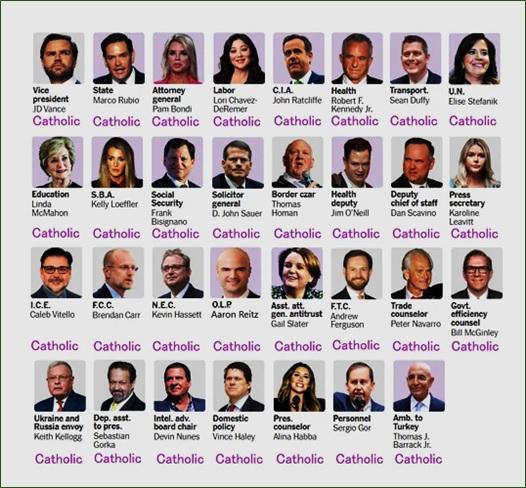
During the Obama administration, roughly half of the members of his cabinet were Catholic, including Vice President Joe Biden, along with six of the nine Supreme Court justices and all senior military and security officials. These proportions are broadly similar to those in the current Trump administration, where 52.5% of cabinet members are Catholic, not including White House Press Secretary Karoline Leavitt.
Furthermore, the three Supreme Court justices appointed by Trump during his first term are all Catholic. *** It is highly likely that Donald Trump does not distinguish between Catholics and Protestants; he certainly knows little about the Bible (which he has described as his second favorite book, after the one he claims to have written, though he has not been able to quote a single passage from it), and he presents himself as an evangelical. His ignorance is so extensive that some of the most eccentric, and showy, evangelical activists have managed to persuade him that their movement, rather than Catholicism, is the cornerstone of his religious coalition. Believing this hoax has been, and remains, a huge mistake, one among many made by the Trump administration. Let’s look at the numbers. According to a recent estimate, there are approximately 62 million Catholics in the United States. According to the same source, “non-denominational” Christians (i.e., the evangelical spectrum, ranging from those who would burn homosexuals at the stake to those who open their churches exclusively to homosexuals) number 21 million, followed by the second-largest denomination, Southern Baptists, with 17.6 million members; mainstream Protestants, that is, the historic denominations (Methodists, Lutherans, Episcopalians, Presbyterians, etc.), number, when combined, 18.5 million. As can be seen, and as Ronald Reagan understood, courting Catholic voters is by far more important than courting evangelicals, both numerically and in terms of political weight. The prominence given to the more extreme and bizarre fringes of evangelicalism — those who argue that law should be explicitly grounded in the Bible, that the Crusades define “Western civilization,” that the return of all Jews to Israel will trigger the Last Judgment, or that secular books should be removed from libraries, etc. — has contributed, on the one hand, to the growth in the number of people who do not affiliate with any religion and, on the other, to increased conversions to Catholicism in the United States. The relative advantage that more extreme evangelical groups, Donald Trump, Pete Hegseth, and their associates are giving Catholics has enabled Pope Leo XIV to bring out his heaviest weapon, the one that can do the most damage: an appeal to “all people of good will” to contact their congressional and local representatives, reminding them that attacks on civilian infrastructure are “against international law” and also represent “a sign of the hatred, the division, the destruction human beings are capable of.” This appeal has been echoed, at times in even stronger terms, by some American bishops. Until the “Trump miracle,” the universal Catholic Church faced some of its most serious challenges precisely in the United States, where a majority of the faithful had moved toward political positions far removed from Rome’s teachings, particularly on immigration and the protection of society’s most vulnerable. The recently converted Catholic J. D. Vance even styled himself as a theologian, reinterpreting Augustine of Hippo’s concept of ordo amoris to justify harsh policies toward immigrants, whether documented or not, going so far as to clash with the Augustinian cardinal Robert Prevost, the future Pope Leo XIV. The problem, of course, was not J. D. Vance’s presumption as the fact that part of the American hierarchy, fearing the loss of the faithful, had begun to waver. A kind of coalition took shape, led on the ecclesiastical front by former nuncio Carlo Maria Viganò and on the political front by Steve Bannon, which went so far as to question the legitimacy of Pope Francis, loosely echoing the abstruse theories of sedevacantists (literally, those who claim that the papal throne is vacant), a schismatic current that emerged after the Second Vatican Council. The difference, compared with the small sedevacantist groups, was that this American resistance, if not outright opposition, could rely on the support of a majority of the faithful within the population. This posed a major problem for the universal Church, given the overwhelming financial weight of its American branch. Among the various interpretations of the election of an American cardinal, this issue has repeatedly been highlighted. Now, the circus of Donald Trump and his faithful war-junky Pete Hegseth is shifting the balance in favor of the Church and against the administration. J. D. Vance’s response — the pope should confine himself to moral issues — is, to say the least, out of line, especially coming from a self-styled theologian, and betrays a certain unease. As of this writing, there has been no statement from Marco Rubio, nor even from Melanija Knavs Trump, a Slovenian Catholic who recently offered a striking glimpse of her flair for impromptu statements. The coalition of incompetents, led by the incompetent-in-chief Donald J. Trump, is making yet another potentially fatal mistake. Undersecretary Elbridge Colby — who is by no means ill-informed — may well have recalled not only the Avignon Papacy, but also another episode in the history of relations between the papacy and political power: the Road to Canossa, when Emperor Henry IV traveled in 1077 to seek forgiveness from the pope, dressed in a monk’s habit, barefoot in the snow, and with ashes on his head, waiting on his knees for three days and nights at the gates of Canossa before being allowed to reclaim his authority.
Manlio Graziano, PhD, taught Geopolitics and Geopolitics of Religions at Sciences Po Paris, at la Sorbonne, and at the Geneva Institute of Geopolitics. He collaborates with the Corriere della Sera and with the geopolitical journals Limes and Gnosis. He founded the Nicholas Spykman International Center for Geopolitical Analysis. He published several books in the US, with Stanford UP, Columbia UP and Palgrave. His latest book is Disordine mondiale: Perché viviamo in un'epoca di crescente caos.
|
|


2.jpg)

| Contact Us | About Us | Donate | Terms & Conditions |


|
All Rights Reserved. Copyright 2002 - 2026